Articles of interest

Monday, February 26, 2018

A Little Piece of Connecticut in Maine


I have a fascination with cemeteries bordering on obsession. I grew up in central Connecticut where old cemeteries were everywhere. Old, as in 250 plus years old. My hometown has several. Our town of Rocky Hill has a really good cemetery filled with brownstone gravestones. Surrounding towns have them.

One of the things that interested me (and still does) is the material used for gravestones in Connecticut. It’s commonly called brownstone. It’s all over the place in Connecticut. It’s a sandstone that ranges in color from a rusty color all the way to a purplish-brown. There are different grades of hardness, the rusty colored stone generally being softer, and the purplish stone harder.


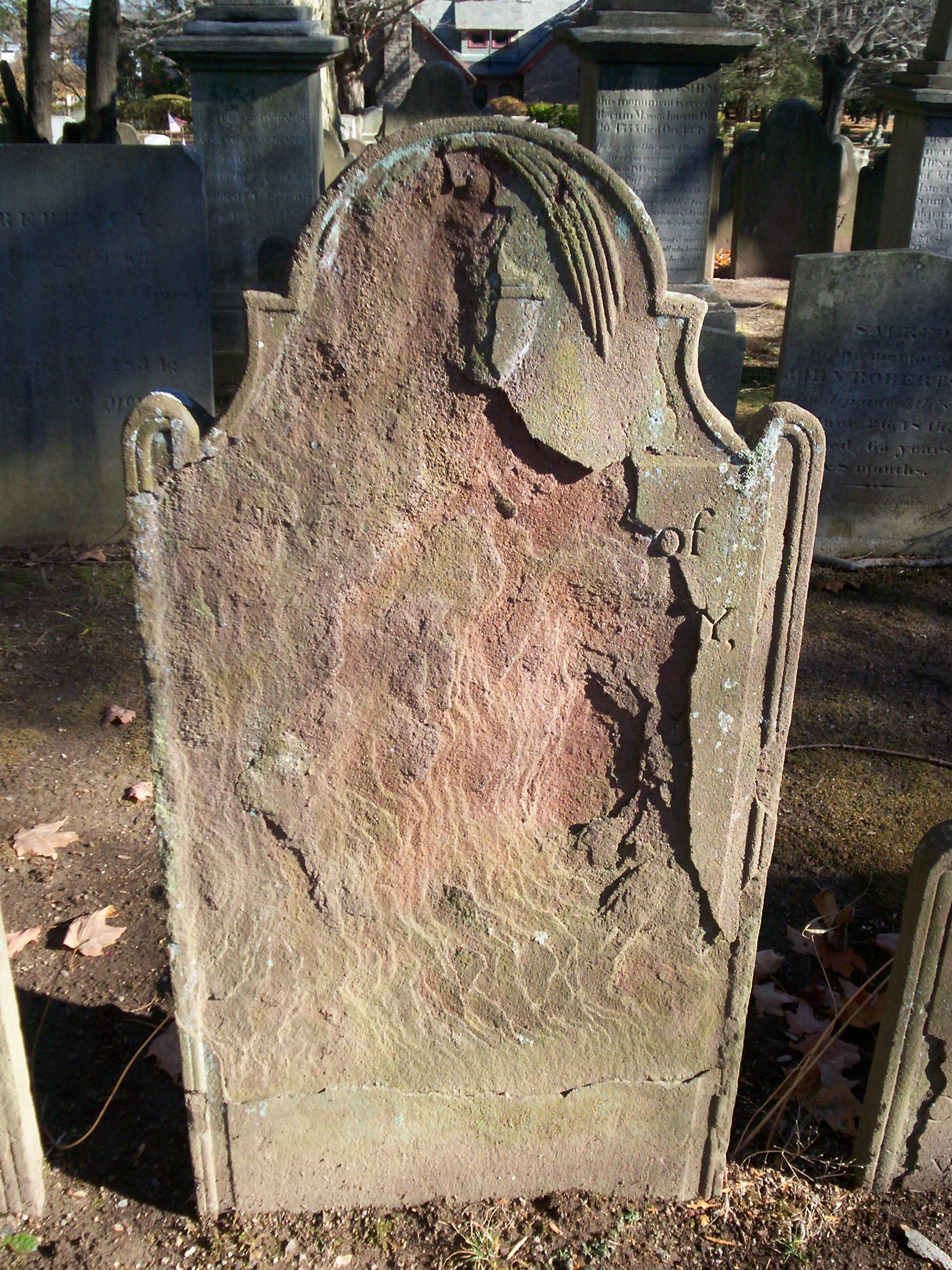
What older brownstone does when exposed to the elements for centuries is that it spalls. A good example is the gravestone of the Avery children. The outer surface becomes harder but the layers directly underneath get soft, in the same way that old brick can do. After years of this erosion, the harder surface will fall apart and potholes will develop on the surface of the stone, destroying the inscription and artwork. Lots of Connecticut cemeteries are full of stones that were intact a century ago but now are totally illegible.


Because of this, I have always been able to spot these brownstone gravestones. One startling example is in Monmouth, Maine, where my family and I lived for eight years. Next door to the church was a cemetery that dates from the 1790’s, which for that part of Maine is about as old as they get. In the oldest section in the front are a number of graves simply marked by a flat piece of rock. Some have initials and a date, some just initials, and some have no markings at all. This indicates that there were no trained gravestone carvers in the fledgling community, and families used whatever they could to mark the grave of a loved one.

In the very front row of this cemetery is a pair of brownstone gravestones that would easily blend in in a Connecticut cemetery but which stand out dramatically in the cemetery in Monmouth. My thanks go to Bobbie Bowler of Monmouth who sent me photos of the gravestones. They mark the graves of Samuel Avery and two of his children. Samuel, whose wife was named Jerusha, Samuel was born on May 12, 1774 in Groton, Connecticut, son of William and Mary Avery, and died at the age of 26 on June 8, 1799. Samuel Avery and Jerusha Arnold were married on June 26, 1796 in New London, Connecticut,
Gravestone of Samuel Avery, Monmouth, Maine
Photos courtesy of Bobbie Bowler


across the river from Groton. I am distantly related to them, also having Avery ancestry through my mother. Their children are buried next to Samuel: Sally, age 8 months and 19 days, died on February 17, 1799. Samuel, age one year, died on March 1, 1799. Clearly, the two children died of an illness that swept through the household that winter. Did Samuel die so young of the same illness, lingering for months? We don’t know. Jerusha died the same year, on November 27, and is buried in the Cedar Grove Cemetery in New London.

I have wondered what the cause of Samuel's death was. Was it accidental, or illness? Recently I came across his will online and it confirms that he was ill for over a month prior to his death. His will of April 23, 1799, in Kennebec County Probate records, is brief and reads as follows:

In the name of GOD amen

I Samuel Avery of Monmouth and County of Kennebec and Commonwealth of Massachusetts being weak in body, but of sound and perfect mind and memory, blessed be Almighty GOD for the same, do make and publish this my last Will and Testament, in manner & form following (which is to say) I give and bequeath unto my beloved Wife Jerusha Avery, all my Estate real and personal, of what kind name or nature four, and wherever to be found and I hereby appoint John Arnold of New London and County of New London, and State of Connecticut Merchant, sole Executor of this my last Will and testament, hereby revoking all former Wills by me made.
In witness whereof, I have hereunto set my hand and seal this twenty third day of April, in the year of our Lord one thousand seven hundred and ninety nine.

His executor was John Arnold, a merchant of New London, and his father-in-law. This is important because it confirms that the couple's New London family was actively in contact with them, and Arnold was undoubtedly the person who arranged for the gravestones.
Gravestone of Avery children, Monmouth, Maine


A tragic ending for a young family, to be sure. It’s not surprising that Jerusha would die so soon after losing both of her children and her husband. The stress she undoubtedly experienced in her grief could have been enough to kill her. Did she move back to Connecticut to be with her family after their deaths? Probably. In that part of Maine at that time marriage prospects would have been minimal, and a single woman would have been in some danger.


It is clear that Samuel and Jerusha came from a family with means. In a cemetery that at the time had nothing but flatrocks for gravestones the two brownstone gravestones would have stood out. Here was a young couple who moved their two children to a remote place. Was it for speculation in land? It wouldn’t be surprising. Whatever the reason, when Samuel and the children died someone clearly arranged for gravestones to be made in Connecticut and shipped up. That in itself would have been an undertaking. Shipping them by sea wouldn’t be difficult. They would have come up the Kennebec River and unloaded at Hallowell or Augusta, the transported by land. Given the lack of roads that alone would have been a major undertaking, done at great cost.
https://images.findagrave.com/photos/2013/325/83985082_138513353511.jpg
Gravestone of Jerusha Avery, Cedar Grove Cemetery,
New London, Connecticut
 https://www.findagrave.com/memorial/83985082/jerusha-avery


There they lie buried in a foreign place. It’s a story that has been lived out again and again. Young people pick up and move to a new place for adventure, in pursuit of wealth, or just to get away from civilization. Whatever their reason for going to Maine, they left behind two little pieces of Connecticut in the place that brought them only hardship and death.

Jerusha's stone, made out of Connecticut brownstone, has suffered the same fate as that of her children. Most of the face of the stone is gone, and only cemetery records now indicate who is buried there. There she lies, forgotten to most.


Wednesday, February 7, 2018

O Who Hath Caused This?

William Blake, Pestilence: Death of the First Born, 1805
O for a voice like thunder, and a tongue
To drown the throat of war! When the senses
Are shaken, and the soul is driven to madness,
Who can stand? When the souls of the oppresed
Fight in the troubled air that rages, who can stand?
When the whirlwind of fury comes from the
Throne of God, when the frowns of his countenance
Drive the nations together, who can stand?
When Sin claps his broad wings over the battle,
And sails rejoicing in the flood of Death;
When souls are torn to everlasting fire,
And fiends of Hell rejoice upon the slain,
O who can stand? O who hath caused this?
O who can answer at the throne of God?
The Kings and Nobles of the Land have done it!
Hear it not, Heaven, thy Ministers have done it!

William Blake, Prologue, intended for a Dramatic Piece of King Edward the Fourth

This is one of my favorite poems, although I have many, many favorite poems, many by Shakespeare. I find it arresting. The imagery is striking. I can see a huge dragon flapping its wings over a battlefield. Blake's question, "O who hath caused this?" is the eternal question in war. Whose fault is it? Nations will usually come up with blame for the other side. "They did it first!" That doesn't matter, in this scenario. Nations engage in war for less than honorable reasons. Wars come about through the failure of nations to be reasonable. Wars happen when nations think short-term rather than long term. World War II, for example. My father is a veteran of the European theatre. He was nearly killed in a rocket attack in London. The war was a necessary one, but only because the West supported Hitler as a bulwark against Bolshevism. Many in the US held eugenics to be a legitimate science--the belief that some races are superior to others. Where did Hitler get that idea? He got it from us.

The bottom line is always who suffers the most. The common soldiers suffer the most. The civilian populations suffer the most. The heads of state and the generals, who assign their sons to a general's staff far away from danger, do not suffer.

As long as nations choose to short circuit diplomacy and go to war, common people will suffer. They will die on battlefields or starve at home.

Our current regime is rattling a saber at a frightening pace. Today President Drumpf called for a military parade in Washington. Such a parade would cost millions of dollars and would fly in the face of concerns about excessive government spending. It would be a demonstration of his own bloated sense of power. Military dictatorships such as the Soviet Union, East Germany and Romania used to put on such parades. So does North Korea. Is this what we want to become? Every day Drumpf is resembling more and more a dictator such as Stalin, who demanded worship from the mindless masses and tolerated no dissent. God help us.

I don't think comparisons of Drumpf to Hitler are quite accurate. I see Stalin as a better comparison. For your perusal I offer a passage from Aleksandr Solzhenitsyn's Gulag Archipelago, in which he  describes the compulsory applause for Comrade Stalin at the 1937 Party Congress that went on for a long time:

A district party conference was under way in Moscow Province. It was presided over by a new secretary of the District Party Committee, replacing one recently arrested. At the conclusion of the conference, a tribute to Comrade Stalin was called for. Of course, everyone stood up (just as everyone had leaped to his feet during the conference with every mention of his name). The hall echoed with “stormy applause, raising to an ovation.” For three minutes, four minutes, five minutes, the “stormy applause, rising to an ovation,” continued. But palms were getting sore and raised arms were already aching. And the older people were panting from exhaustion. It was becoming insufferably silly even to those who adored Stalin. However, who would dare to be the first to stop? The secretary of the District Party could have done it. He was standing on the platform, and it was he who had just called for the ovation. But he was a newcomer. He had taken the place of a man who’d been arrested. He was afraid! After all, NKVD men were standing in the hall applauding and watching to see who would quit first! And in the obscure, small hall, unknown to the leader, the applause went on—six, seven, eight minutes! They were done for! Their goose was cooked! They couldn’t stop now till they collapsed with heart attacks! At the rear of the hall, which was crowded, they could of course cheat a bit, clap less frequently, less vigorously, not so eagerly—but up there with the presidium where everyone could see them'
The director of the local paper factor, an independent and strong-minded man, stood with the presidium. Aware of all the falsity and all the impossibility of the situation, he still kept on applauding! Nine minutes! Ten! In anguish he watched the secretary of the District Party Committee, but the latter dared not stop. Insanity! To the last man! With make-believe enthusiasm on their faces, looking at each other with faint hope, the district leaders were just going to go on and on applauding till they fell where they stood, till they were carried out of the hall on stretchers! And even then those who were left would not falter… Then, after eleven minutes, the director of the paper factory assumed a businesslike expression and sat down in his seat. And, oh, a miracle took place! Where had the universal, uninhibited, indescribable enthusiasm gone? To a man, everyone else stopped dead and sat down. They had been saved! 
The squirrel had been smart enough to jump off his revolving wheel. That, however, was how they discovered who the independent people were. And that was how they went about eliminating them. That same night the factory director was arrested. They easily pasted ten years on him on the pretext of something quite different. But after he had signed Form 206, the final document of the interrogation, his interrogator reminded him: “Don’t ever be the first to stop applauding!”


Take it a day at a time

Not marble nor the gilded monuments
Of princes shall outlive this powerful rhyme,
But you shall shine more bright in these contents
Than unswept stone besmeared with sluttish time.
When wasteful war shall statues overturn,
And broils root out the work of masonry,
Nor Mars his sword nor war’s quick fire shall burn
The living record of your memory.
’Gainst death and all-oblivious enmity
Shall you pace forth; your praise shall still find room
Even in the eyes of all posterity
That wear this world out to the ending doom.
    So, till the Judgement that yourself arise,
    You live in this, and dwell in lovers’ eyes.
Shakespeare, Sonnet 55

Shakespeare's profound words raise the most uncomfortable issue of all in human existence--that nothing lasts for ever, not even us. He seems optimistic, though, that memory will suffice in keeping one's existence alive. A recent article suggests that the cultural malaise that we seem to be in--of unhappiness, stems from our habitual overuse of electronics.  The cure--get out and do something. Talk to people. Go to church, read a book, take a walk, do something.  I believe this is true. Countless times I have seen couples eating out who are both scanning their phones, presumably on Facebook, looking for the perfect post--the one that will fulfill all desire, that will make them ultimately happy. The sad truth is that it will never come. Nothing available online will finally satisfy that eternal quest for ultimate meaning. Vaguebooking and coming up with nothing substantial only makes the user more unhappy because he or she never finds what they are looking for. It's the modern permutation of channel surfing.

Shakespeare wrote at the end of the Renaissance, when the English Renaissance was coming to a close and the even flashier Baroque era was ramping up. A preoccupation of the Renaissance was the realization of mortality. Shakespeare's poetry, whether in the sonnets or his plays, echos that preoccupation.

I believe the root of unhappiness in contemporary society lies in our refusal to acknowledge death as a part of life. We've made some progress in that regard. Hospice is now widespread, almost universal in the U.S., and helps the family and the patient both to ease into the next world. But we're still unhappy. Certainly the death of a young person (I'll let you decide what is "young") seems unjust, but we have come to see all of death as unfair and unjust, as though we somehow had a guarantee of everlasting life without pain.

It seems to me that some people go through life always hoping for something more. Perhaps all of us do that to one extent or another. The grass is always greener on the other side of the fence. "My soul shall not rest until it rests in you," Augustine wrote to God in his Confessions. By nature we are always looking ahead to what is better. Unfortunately that can easily translate into never being satisfied with anything in life. That's not a happy way to exist, yet many people do exactly that. Balance this with the sense of entitlement that life should be trouble-free and you have a recipe for unhappiness. Serious unhappiness. Take it a day at a time.


Sunday, January 21, 2018

O Where Are Kings and Empires Now

In 2013 I had the opportunity to travel to Istanbul. I was there for a week so I had the chance to visit a number of historic sites in the city.

Istanbul, of course, is the modern permutation of Constantinople, the wealthiest city in the ancient world. Constantinople was the gateway to the wealth of the East. The Italian city states of Venice and Genoa had branch offices there to get a piece of the action. These cities dominated trade, and became fabulously wealthy as a result.

One of the most interesting sites was the Hippodrome. The Hippodrome was a circus, a long chariot track. Chariot racing was central to Roman identity. It was one of the premier entertainments along with gladitorial contests. But this wasn’t just any circus. It was the Emperor’s circus. It ran alongside the royal palace, and the Emperor had a special box that was accessible to the palace. This was royal theater at its best. The Hippodrome was not just used for chariot races, but was also used for large imperial public events.

The Hippodrome now sits next to the Blue Mosque, which stands on the site of the Church of the Holy Apostles, the burial site of Byzantine Emperors for centuries. The outline of the track is still there, with the track itself paved with asphalt. Chariots don't race there anymore. Taxis do. The perimeter is mostly cafes and shops--a number of shops selling pashmina shawls and things like that.

As I sat at a cafe I thought about the chariot races that were held there and tried to imagine them whipping around the curve. I also thought about the emperor Justinian luring the rival factions after the Nike riots into the Hippodrome, then shutting the gates and slaughtering 30,000 of them. A profound moment.

The base of the obelisk, which came from Alexandria and was erected by the emperor Theodosius in the late 4th century, has reliefs depicting the Emperor and his court, including the submission of the barbarians. I spent some time with this, thinking about the moment captured in time, when Byzantium was in its glory, the Emperor ruled over the world, and everything was wonderful and stable. The marvelous thing about art such as this is that it freezes a moment in time. It's a fantasy, I know, but it's wonderful to be drawn into this fantasy scene for a few minutes. In this sculpture, the Emperor is eternally reviewing the charioteers and waving to the adoring crowds. It's almost as if everything that happened after never actually happened--the Crusades, the World Wars, the Holocaust, 9/11. How much history has passed by the relief of the Emperor and his retinue awarding the laurel wreath to the winner of the race. This gave me pause, looking on a scene from 1600 years ago, when the Emperor couldn't imagine anything better than what he saw from his private box. This was a wonderful opportunity to reflect on mortality. It makes me think of the opening line of an old hymn:

O where are kings and empires now
Of old that went and came?

Saturday, December 23, 2017

It's Only a Pawn

White pawns from the Charlemagne chess set, ca. 1050

I’ve decided to write a history of chess pieces, one piece at a time. I’m hardly the first person to do so, but I thought it would be fun. All the pieces were either made by me or are in my collection.

It might seem appropriate to start with the king, the focus of the entire game. Trapping the king is the central goal of chess. But, I’m not going to do that. Instead, I’m going to start at the bottom, the lowly pawn.

Pawns have gotten a bad rap over the years. A commonly used phrase, often by talking heads on History Channel documentaries, is that people of lesser standing were moved around by kings and the nobility “like pawns on a chessboard.” What they fail to understand, of course, is that ALL the pieces on a chessboard are moved around by the player. Duh. I guess they'd be easy to checkmate! Part of what is behind that sort of phrase is the idea that pawns were worthless, disposable, just cannon fodder to protect the king and his court. Actually, that is not true.

This was even more untrue during the Middle Ages. When chess came to Europe around the 8th century it was a very different game. The queen was not a queen, but a vizier or general (and the weakest piece on the board), the rook was a chariot, the bishop was an elephant with limited moves, and the other pieces were the same as today. In such a game, with only the rook having unlimited movement in one direction, action in the game was more localized. Hence, the pawns were very important strategically. They were used to form a barrier against the forward movement of the other side.

Even in modern chess pawns can be very powerful. You can checkmate with a few pawns with cover. Really.

This did not make them less valuable, cannon fodder (although there weren’t cannons in Europe at the time), disposable pieces of lesser value. They had a great deal of value. They were often used in a way that they were captured, given that there were eight of them. That didn’t make them less valuable. They were used strategically.

Having said that, the uniformity of pawns in medieval chess might give the impression they were less valuable. They represented foot soldiers, of which there were more than there were of other components of the army.

As chess evolved in India the pieces represented the four parts of an army. The rook was the chariot, capable of high speed movement straight ahead. The knight, which along with the rook has retained its original movement since the beginning, was more nimble and could turn off if necessary. The bishop (at the time an elephant) was limited in movement, but if it were in the right place it could be devastating. Finally, the pawn represented the infantry--soldiers on foot, not in a chariot, riding a horse or elephant, and carrying a shield and spear. All parts of the army were important, and each had its own function.

l to r: Persian/early European pawn, ca. 1000;  Lewis Chessmen, ca. 1100; Spanish, ca. 1250, Scandinavia, ca. 1300 Russia, ca. 1350; England, ca. 1480; Italy, ca. 1490; Germany, ca. 1500


The development of the chess pawn is an interesting one. The pawn as it came out of Persia in the 7th century was small, with some decoration. Most pieces from this period resemble that form. The pawns in the Lewis Chessmen are similar, with two designs, perhaps reflecting two different sides. The rest of the pieces are figural, and I’ll get to them another time.

l to r: England, ca. 1560; Italy, ca. 1600; England, ca. 1700; Portugal (made in India) ca. 1650; France, ca. 1750; England, ca. 1750, England, ca. 1830
Regional variations on the pawn cropped up in various parts of Europe. In places the pawn became somewhat bottle shaped, with a small neck that was easy to pick up. In many parts of Europe, the pawn remained a the simplest piece, taking the shape of a barrel or cylinder with minimal decoration. Some examples are illustrated here. One notable exception is the pawn in the so-called Charlemagne chess set now in Paris, made in Sicily during the eleventh century. Here the pawn is a foot soldier.

As time went on pawns were still uniform in shape but took on many different designs. In places they retained that bottle-shaped form, while disks and other additions mad them more elaborate. In some designs the pawn became a miniature of the bishop and/or queen, such as in the Regence style. In the case of the ubiquitous Staunton design, introduced in England in 1849, the pawn had its own design not based on another piece.
l to ro: English, bone, ca. 1860-1900; German, wood, ca. 1840-80; French, Staunton design, wood,  ca. 1920; German, wood, ca. 1860-80; French, Regence design, wood, ca. 1880; Irish, Killarney, wood, ca. 1880; Russian, wood, ca. 1950. The only piece I made here is the Killarney piece.


Pawns are almost always the shortest pieces on the board. That has remained consistent. That does not make them of less value or insignificant, however. In modern chess the pawn can be promoted to any piece the player desires once it has made it to the other side. It often takes most of the game to get a pawn to the last rank on the other side. It is very rare for a player to get more than one pawn to the other side. Generally players will promote their pawn to a queen, since it is the most powerful piece on the board. New chess sets today quite often will have an extra queen for each side. That was not true when I was learning how to pay as a kid. Back then, you took a rook and turned it upside down to make a second queen. That’s why rooks in old sets will often have damage to the top.

Enjoy the photos of pawns through the ages!

Thursday, December 14, 2017

In The Bleak Midwinter

“In the Bleak Midwinter” is one of my favorite Christmas hymns. It is based on a poem by Christina Rossetti, published in 1870. The hymn first appeared set to music in a 1906 hymnal.

The first verse sets the mood:

In the bleak mid-winter
Frosty wind made moan;
Earth stood hard as iron,
Water like a stone;
Snow had fallen, snow on snow,
Snow on snow,
In the bleak mid-winter
Long ago.

Rossetti wrote out of her own experience if winters in England. Anyone who grew up in a northern climate can relate to the image of cold winds blowing and the ground hard as iron, water as hard as stone. I can remember winters like that in northern New England. With climate change we’re not seeing those typical conditions as much, especially in balmy Connecticut. However, the image persists.

The best way to see how this tag team of Christmas and winter functions is to see what Christmas is like outside of New England. We take for granted the Currier and Ives images of riding a sleigh carrying the Christmas tree home where pumpkin pie and a roast await, with the fireplace burning brightly. My first glimmer of this was in Arizona a number of years ago. Anita and I were there on our honeymoon, and we went to a Lowe’s to see what they had for desert plants which we can’t get here. I have the two cacti that we bought in my office at the church for the winter. It was mid-October, and just like anywhere else the Christmas decorations were up. Bear in mind that this was Phoenix, Arizona, hardly a winter climate. They had artificial Christmas trees for sale. It looked incredibly out of place, in the same league as the bright green lawn we saw in front of a Phoenix mansion, sprinklers running at full tilt.

It occurred to me that many people living in the area were transplants from somewhere else, people from colder regions where a live spruce or fir tree was not exotic, and this appealed to nostalgia for home.

I was in the Holy Land six and a half years ago in March, and it was cold some of the time, but not winter as we experience it. Jesus wasn’t born in December anyway. The leaders of the early Church put his birthday there to counteract the Roman celebration of the Saturnalia, a bawdy, raucous holiday that they didn’t want their people celebrating.  Better to be celebrating Christ’s birth than getting blind drunk, although that hasn’t stopped anyone lately. For some, Christmas is the Saturnalia.

For many, winter is difficult. Those who grew up in northern climates often eat more, exercise less, drink more, and wrestle with depression. It’s no wonder that Russia has one of the highest rates of alcoholism in the world.

So, even if Jesus wasn’t born during the winter, the image of Christ coming to us in our winter is still an apt one. Jesus comes to us not when we are feeling good about everything, but when we struggle with all that bedevils us. That’s the meaning of the Incarnation. 

Saturday, December 2, 2017

The King and Queen are Tipsy: How Chess Pieces Age

Lardy Staunton queen, France, ca. 1920
Regence style king, France, ca. 1880
Chess pieces are an art form. I've discovered that in my ongoing obsession with turning chess sets. I've bought a few antique sets here and there, and enjoy playing a game with a set that is over a century old. One of the peculiar things that happens to some sets is the king and/or queen get tipsy. Literally. Case in point is these two pieces, both a century or more in age. You'll notice that the warping has occurred at the thinnest point of the piece. The kings and queens are more susceptible than the other pieces to this kind of warping because they are the tallest pieces in each set. In the case of the Staunton queen, to the left, there is only one narrow junction. In the Regence king, to the right, there are three, making for three narrow places where warping can occur. Instead of this being a problem that diminishes value, it actually establishes their age as a century or more, since this type of warping generally doesn't happen with new pieces.

Old chess sets will often be very dirty, and I always give them a good cleaning with Murphy's Oil Soap to restore the surface. I sometimes will make repairs, and a few times I've had to reproduce a missing pawn or two.

Regence knight, ca. 1880
Other chess pieces age gracefully to one degree or another. This Regence knight, from the same set as the king above, has a crack (called a "check" in woodworking lingo) on the ball below the horse's head  from the wood drying out. Some people might try to glue and clamp this, or fill the crack with some sort of filler, but that wouldn't be a good idea. This crack will probably close up somewhat when it gets warmer and more humid.

South German king, pawn, and queen, ca. 1870-90.
Wear is another way in which pieces age. If they are used a lot, the finish on chess pieces will wear off on the highest points of the turned piece, as you can see in these three pieces from the black side of a ca. 1870-90 German set (king, pawn, queen, left to right). There is wear on the top of each pieces. Sometimes wear like this can be unsightly, and many times, as with this set, it testifies to its age and use. It's part of the patina.

Rooks also suffer damage from use. Rooks are particularly susceptible to breakage because until recently there was only one queen on each side in a chess set. Generally, new chess sets today include a second queen, only to be used if a pawn is promoted. If a player got a second queen by promoting a pawn, if the player did not simply regain his or her queen from capture they traditionally would use a captured rook turned upside down as a second queen. Eventually this can lead to the crenelations on the top of the rook to break off, as has happened to the rook on the right from a St. George style set, ca. 1880-1900. An intact rook is to the left.

In Japanese nomenclature the term wabi-sabi has become popular in the West. It simply means the characteristics that give an object an patina, a sense of having been used or worn. I think this is the appeal of sets that show their age--you know that a century or more ago someone was enjoying a game of chess with a friend.