I am a dinosaur. I know it, and am proud of it. I am at the age where I can remember life without computers and the Internet. Don’t get me wrong, both are wonderful things. I just remember what life was like without them.
I can remember when it was a big deal when a movie premiered on television. I can remember that each August the Wizard of Oz was on national television, and everything stopped cold. In the slightly previous generation it was said that during the commercials during “I Love Lucy” the water pressure in cities would drop as people used the bathroom and flushed in unison.
And, I still write things by hand. Notes at meetings, and most especially, notes for my sermons.
There are really two ways to preach--one is to read your sermon from a manuscript, or to preach extemporaneously. I do the latter, using anywhere from six to eight pages of handwritten notes. A sample is shown here.
Awhile ago a colleague suggested that because I didn’t write my sermons on my computer and didn’t read them from an iPad, I would be considered old-fashioned. So I am. Let it come. I will retire in about ten years, maybe do a couple of interim positions before retiring completely.
I have been preaching for thirty six years, and have never regretted doing it the way I do. No, it isn’t trendy, and I don’t wear trendy clothes either. If that’s what is going to attract people to my church, then that’s pretty shallow. Although some evidence may argue to the contrary, I refuse to believe that my children’s generation is shallow enough to place image before substance.
Many people don’t write by hand that much. No surprise there. A lot of people don’t read books, either. We have ways of communicating that don’t involve a pen and paper--texting, email, Twitter, and all the other forms of electronic instant gratification. Using pen and paper is becoming a lost art.
So, my use of handwritten notes for preaching is a form of rebellion. It is quaint, I guess. The stylish thing is to use an iPad. I understand, that it’s easier than bringing paper into the pulpit. It’s just a modern version of typing out the sermon. It still leaves me cold. Then again, reading a sermon from paper (or an iPad) leaves me cold too.
A number of years ago a parishoner asked me if I could make a copy of my sermon, as it had resonated with him. I told him that I use handwritten notes, and that he probably wouldn’t be able to read my handwriting. He said that he was able to read pretty bad handwriting. So, I copied the notes for him. He told me the next week that he couldn’t read my handwriting, and he appreciated the effort. I told him I sometimes can’t read my own handwriting either. That’s what appears as a pregnant pause.
People will ask me on a Saturday sometimes if I have my sermon done for the next day. I’ll always say “no.” They will ask when it will be done, and I’ll respond that it will be done when I’m done preaching it. Preaching is always spoken. It’s another one of those arcane things that we do in the church. It isn’t electronic. It’s me and my handwritten notes talking to a group of people.
I like it that way. I believe they do to. Instead of reading to them, I’m talking to them. That's the bottom line.
Blog for the Rev. Craig L. Cowing, Pastor and Teacher, Musician, Artist, Professional Dumpster Diver, and N'er-Do- Well. Thoughts on art, music, chess, history, stamp collecting, reed organs, genealogy, minutiae, irrelevantia, useless trivia, and retrospectivia.
Wednesday, August 31, 2016
Monday, August 22, 2016
Sound From the Past
Lately I’ve been spending a lot of time in the basement, working on my woodturning lathe. In particular, I’ve been working on a couple of chess sets. I do things in spurts until I get tired with it, then move on to something else. I will get back to a few paintings that I haven’t finished, but right now, woodturning feels just right.
I remember many years ago that our family was in a museum of some sort, I can’t remember where. It was when I was a kid. I remember there were rooms from several different 19th century shops, and you could press a button and hear sounds that would have been heard in the particular shop you were looking at. Workshops have always felt like home to me. My father always had one in the basement, and I have many fond memories of working on projects with him, and sometimes alone. Since we’ve moved to Rocky Hill I have the best workshop I’ve ever had, and it’s ours. We own the house (that is the bank does, for the next 29 years more or less). This time around I dont’t feel as though I’m just camping out for the next five or six years until it’s time to move again.
So, my workshop is shaping up. Last night as I was turning the second king for my oversized South German/Czech chess set, which is related to the Vienna Coffee House style, I was listening to the sound of the knife as it was cutting the wood and I realized I had heard that sound before. Not just recently, because I’ve done a lot of turning over the last few years. It was almost an archetypal sound, one that you can’t quite put your finger on but sounds so familiar. After a few minutes I realized it was one of the sounds I had heard in the museum so many years ago, that sound that stuck with me.
I discovered woodturning in high school. I made a few things, none of which I have now. I realized that I really enjoyed it. After high school I worked in a pewter shop, learning how to spin pewter. Then I left a year later and went to college. Spinning is done on a lathe. I never quite got the hang of that, but it was interesting.
Then, many years went by until someone gave me a lathe, which is the one I use now. It’s almost meditational, because you have to focus on what you’re doing. The rule is that you never look away from your work when you have the tool engaged with the piece of wood you’re turning. One false move and you could have that tool stuck in your shoulder, or worse, in the middle of your forehead. One tiny slip is all it takes. So, focus is the thing.
I learned a number of years ago that my great grandfather (my paternal grandmother’s father) was an expert woodturner. I always knew that he had a woodworking shop where they made victorian trim for houses, and furniture. I have a piece that was made in his shop. But apparently turning was his specialty. I thought about him as I reflected on the sound my tool made against the wood. It reminded me that it is an old sound, the same sound that a woodturner would have made centuries ago. It was not a sound made by a table saw or a router. Sure, the machine was run by electricity instead of water or steam power, but it was an old sound that my great grandfather would have been very familiar with.
It’s funny how little things can bring me back in time. Time to go downstairs and make a couple more chess pieces.
Wednesday, May 18, 2016
Poverty and the Spiritual
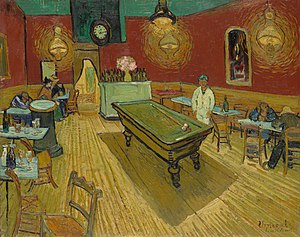
A few weeks ago Anita and I went to the Yale Art Gallery. I’ve
known about it for a long time but had never been. One painting in particular I
wanted to see was Vincent Van Gogh’s “Night Café.” This famous painting has
been in New Haven for about fifty years.
He painted it to settle his debt with the
café owner, who was also his landlord.
The painting depicts an all-night café in Arles, France,
where Van Gogh was living at the time. He described the café in letters to his
brother: “Night
prowlers” can take refuge there when they have no money to pay for a lodging,
or are too drunk to be taken in.” He later described his goal in making the
painting: "In
my picture of the Night Café I have tried to express the idea that the
café is a place where one can ruin oneself, go mad or commit a crime.”
A
place of desperation, perhaps?
Van
Gogh was a deeply spiritual person, to use contemporary terminology, but he
rejected organized Christianity as an institutionalized faith that did not
address the basic needs of people. He attempted to prepare for the ministry,
spending several years working among the poor in both England and his native Holland.
His mentors felt he spent too much time among the poor. He gave up his hopes of
being a pastor and floundered for awhile before discovering art. His early
paintings are dark, and depict the poor as they live their lives in
desperation. Several years into his brief, ten year art career he discovered
color, and the style that he is known for was born. Van Gogh struggled with
depression and anxiety during his adult life, and committed suicide in 1890 at
the age of 37.
| Vincent Van Gogh, Night Cafe, Yale University Art Gallery |
Van
Gogh’s paintings, for the most part, are not religious, but many have a
theological or spiritual meaning. Many of his paintings portray the beauty of
creation. His portraits celebrate the uniqueness of individuals. His earlier
paintings, although not nearly as well-known as his later works, depict the grinding
pain of poverty. That is also a theological concept.
People
often ask where God is amidst suffering. It is natural to feel abandoned by God
in the midst of suffering. Although not an easy answer, one response is that
God is present in suffering. That isn’t to be trite. God is present with us in
the midst of our suffering, present in the person of Jesus. In Christ, God is
present in the suffering of the poor. And, God is present in the hands of those
who offer hope to the poor. Van Gogh understood this, and unfortunately the
world did not understand. I wonder if the world ever
will understand.
Monday, May 16, 2016
Copying the Masters
![]() | |
| Hans Holbein self portrait, 1542 (my copy) |
Mrs. Gardiner stipulated that the collection remain the same, including the building itself. It is a wonderful turn of the century mansion with architectural elements collected across Europe, and of course, many paintings.
The way the paintings are displayed is in the manner of a home at that time. Many of the smaller paintings are on stands, back to back, with a chair in front of each one. I’m sure that at one time visitors were allowed to sit in the chairs, but not now. This sort of arrangement is conducive to the sort of intimacy I look for in the display of art. Even if I can’t sit in the chair in front of a painting, I still get the feeling of intimacy, of having the small Giotto or Bellini to myself, to converse with it.
What does this have to do with copying paintings? Quite a bit, actually. I have never been one for art prints. Of course, many enjoy art prints, and that’s perfectly fine. For me, viewing a print of a painting is too many steps removed from the original. For one, the print is generally smaller than the original. The sense of size is lost. Also, it’s not a painting. There is no texture, no impasto, no depth in a print. Standing in front of a Picasso I can see how he applied the painting, sometimes almost like spreading icing thickly on a cake. It gives me the feeling that I’m looking over the artist’s shoulder.
![]() | |
| Jan Van Eyck self portrait, 1433 (my copy) |
For me, intimacy is an absolute necessity in art, whether I’m contemplating a painting I’ve copied or viewing one in a museum. It is the intimacy of the artist and me. For that moment, the artist and I are having a conversation, often over the span of centuries. That’s why I especially enjoy copying self portraits by artists. Van Eyck’s self portrait (1433) is a great example. The artist portrays himself as he is--getting older, needing a shave, and just basically being human. Hans Holbein painted several self portraits, one in the form of a sketch which I have turned into a painting. He’s just another guy.
![]() | |
| Vincent Van Gogh self portrait, 1887 (my copy) |
Vincent Van Gogh’s self portraits are deeply psychological, as many self portraits are. His seem to be even more so. I chose to copy one that I have actually seen in the Wadsworth Athenaeum in Hartford, Connecticut, just a short distance from where we live. In this painting he depicts himself as looking back over his shoulder at a world that he seems to distrust. He wasn’t a fool. The world can’t be trusted, not completely.
I’ll post some more copies from time to time as I add to my collection. Right now I’m working on a copy of Mantegna’s Adoration of the Magi, currently at the Getty Museum in California.
Saturday, September 19, 2015
Copying the New Testament in Greek
I haven't posted in awhile, but I I thought I would try to get back to it. Last week I just started as the pastor of Rocky Hill Congregational Church, UCC in Rocky Hill, Connecticut, and I've had a lot to do to get going.
This week I started a new project, as if I didn't need any more! It started when my wife and I were in Barnes and Noble and in the journal section I noticed they had handmade journals that were identical in appearance to the codices used for early papyrus copies of the various books of the New Testament. The price was right so I picked up a couple. I had started hand-copying the New Testament in Greek last year but I eventually lost interest because I had made some formatting decisions that didn't work out. This time I've simplified it. I am estimating I will be able to put all the New Testament into five of these volumes.
The early manuscripts of the New Testament did not include the entire thing because the book would be too large. Instead, sections of the New Testament circulated separately, such as the four Gospels, the letters of Paul, etc. The typical cover appears to have been leather with a flap and a tie to keep it closed.
I am currently near the end of Matthew 5, the first chapter of the Sermon on the Mount. The Greek script I am using is based on that in Papyrus 66, the Bodmer Papyrus, which contains the Gospel of John. It dates from around 200 AD and has a very clear, readable text. I am using a cartridge fountain pen with a fine point. I found that one cartridge will do about a dozen pages. That will be a lot of cartridges!
I find this to be a very restful, meditative activity in the evening or for a break during the day. As I copy the text (the UBS 4th edition text) I try to remind myself what the Greek means. My Greek isn't as good as it once was. I remember that since manuscripts were time-consuming to produce, many people would have only heard the text being read rather than reading it themselves, if indeed they could even read.
It's also interesting to remember that for all but the last five centuries the only books available were handwritten. This was the only way information was transmitted in book form. A person was using contemporary technology when they read a manuscript book. Whole industries centered around the production of materials for books, and for the actual writing of them. Imagine the impact the printed book had on the world.
The funny thing about manuscripts from this time is the way the words all merge together. There's no break between words. It seems to make it more difficult, but for someone who read Greek with ease it wouldn't present any difficulty. Try reading this:
THESEWORDSAREALLMERGEDTOGETHERBUTSTILLARENOTDIFFICULTTOREAD.
I will post more as I make progress.
![]() |
| A modern codex |
The early manuscripts of the New Testament did not include the entire thing because the book would be too large. Instead, sections of the New Testament circulated separately, such as the four Gospels, the letters of Paul, etc. The typical cover appears to have been leather with a flap and a tie to keep it closed.
![]() |
| The first page of Matthew |
I am currently near the end of Matthew 5, the first chapter of the Sermon on the Mount. The Greek script I am using is based on that in Papyrus 66, the Bodmer Papyrus, which contains the Gospel of John. It dates from around 200 AD and has a very clear, readable text. I am using a cartridge fountain pen with a fine point. I found that one cartridge will do about a dozen pages. That will be a lot of cartridges!
I find this to be a very restful, meditative activity in the evening or for a break during the day. As I copy the text (the UBS 4th edition text) I try to remind myself what the Greek means. My Greek isn't as good as it once was. I remember that since manuscripts were time-consuming to produce, many people would have only heard the text being read rather than reading it themselves, if indeed they could even read.
It's also interesting to remember that for all but the last five centuries the only books available were handwritten. This was the only way information was transmitted in book form. A person was using contemporary technology when they read a manuscript book. Whole industries centered around the production of materials for books, and for the actual writing of them. Imagine the impact the printed book had on the world.
The funny thing about manuscripts from this time is the way the words all merge together. There's no break between words. It seems to make it more difficult, but for someone who read Greek with ease it wouldn't present any difficulty. Try reading this:
THESEWORDSAREALLMERGEDTOGETHERBUTSTILLARENOTDIFFICULTTOREAD.
I will post more as I make progress.
Thursday, June 25, 2015
Cemetery musings
Recently I attended a family memorial service in Massachusetts, and since it was a Saturday I took my time coming home. I stopped in a couple of old cemeteries that I had visited close to 20 years ago, and this time I had my camera.
Cemeteries are familiar places to me. A common family pastime when I was growing up was to stop in an old cemetery and look at the stones. As a pastor I spend a great deal of time in cemeteries, relatively speaking. I am comfortable in them, and at times I can almost feel the presence of the departed souls whose bodies lie beneath the earth.
One cemetery I visited is in Littleton Common. The oldest stones date back to the 1720s. The other is in Billerica. Both are very old communities, and these two cemeteries reflect that long history.
I'm including some of the many pictures I took. The first one is from the Billerica cemetery. This stone was in the oldest part of the cemetery which dated from the 1690's to the 1720's. The style of the stones reflected this time period, being fairly small in size with rather cramped winged skulls, and sometimes elaborate decoration around the skulls. Several stones were not carved by professional stone cutters but were obviously home made. Only one had a date (1736) while the others had initials and no other carving. This particular stone has the initials "L.F." without any indication who this was. Some families resorted to homemade stones either because professionally carved stones were expensive or because the stone cutter was far away, or both.

The next stone is in Littleton, Mass. Similar stones appear across northeastern Massachusetts. They generally date from the 1720's through the 1760's, and feature a simple folk art-style face with rosettes and other simple decorations. I suspect that the origins of the decorations go back to pre-Christian Anglo Saxon England, but I don't know for sure.

The two small stones above with winged skulls date from 1719 (top) and 1694 (bottom). If you look closely under the skull on the top stone you will see an hourglass under the lichen. To the left and right of the hourglass are the inscriptions "Memento Mori" ("Remember Death") and "Fugit Hora" ("The hours fly"). Stones from this time period were intended to be reminders that life comes to an end.
To the right is the top part of the gravestone of the Rev. Samuel Ruggles in Bilerica, who died in 1749. Considering this stone likely dates from the 1760's, it probably replaced an earlier stone. The notable feature of this stone is the portrait carved at the top. This is one of two such stones in the Billerica cemetery, carved by the same hand. The lengthy inscription is in Latin and praises his gifts as a pastor. The Latin inscription also makes a rather obvious statement that if the reader isn't educated enough to read Latin then he/she shouldn't bother.

To the left is another beautiful slate stonein Littleton, probably carved by the same person as the Ruggles stone. Dating from 1769 it sports a very finely carved angel with an hourglass and the text "Memento Mori" above.
Below is another winged angel in Littleton from 1779. The striking head of the angel was a hallmark of a family in northern Massachusetts whose name escapes me.
The last stone for now is also in Littleton, carved by the same family as the angel to the right. This stone marks the grave of a five year old girl who died in 1768. Children's graves are all too common in cemeteries from this period. I have seen graves of children of one family who all died within a few weeks of one another. Sometimes an entire generation in one family would be wiped out in that way. It is impossible to even begin to understand the parents' grief.
Cemeteries are familiar places to me. A common family pastime when I was growing up was to stop in an old cemetery and look at the stones. As a pastor I spend a great deal of time in cemeteries, relatively speaking. I am comfortable in them, and at times I can almost feel the presence of the departed souls whose bodies lie beneath the earth.
One cemetery I visited is in Littleton Common. The oldest stones date back to the 1720s. The other is in Billerica. Both are very old communities, and these two cemeteries reflect that long history.
I'm including some of the many pictures I took. The first one is from the Billerica cemetery. This stone was in the oldest part of the cemetery which dated from the 1690's to the 1720's. The style of the stones reflected this time period, being fairly small in size with rather cramped winged skulls, and sometimes elaborate decoration around the skulls. Several stones were not carved by professional stone cutters but were obviously home made. Only one had a date (1736) while the others had initials and no other carving. This particular stone has the initials "L.F." without any indication who this was. Some families resorted to homemade stones either because professionally carved stones were expensive or because the stone cutter was far away, or both.

The next stone is in Littleton, Mass. Similar stones appear across northeastern Massachusetts. They generally date from the 1720's through the 1760's, and feature a simple folk art-style face with rosettes and other simple decorations. I suspect that the origins of the decorations go back to pre-Christian Anglo Saxon England, but I don't know for sure.

The two small stones above with winged skulls date from 1719 (top) and 1694 (bottom). If you look closely under the skull on the top stone you will see an hourglass under the lichen. To the left and right of the hourglass are the inscriptions "Memento Mori" ("Remember Death") and "Fugit Hora" ("The hours fly"). Stones from this time period were intended to be reminders that life comes to an end.
To the right is the top part of the gravestone of the Rev. Samuel Ruggles in Bilerica, who died in 1749. Considering this stone likely dates from the 1760's, it probably replaced an earlier stone. The notable feature of this stone is the portrait carved at the top. This is one of two such stones in the Billerica cemetery, carved by the same hand. The lengthy inscription is in Latin and praises his gifts as a pastor. The Latin inscription also makes a rather obvious statement that if the reader isn't educated enough to read Latin then he/she shouldn't bother.
To the left is another beautiful slate stonein Littleton, probably carved by the same person as the Ruggles stone. Dating from 1769 it sports a very finely carved angel with an hourglass and the text "Memento Mori" above.
Below is another winged angel in Littleton from 1779. The striking head of the angel was a hallmark of a family in northern Massachusetts whose name escapes me.
The last stone for now is also in Littleton, carved by the same family as the angel to the right. This stone marks the grave of a five year old girl who died in 1768. Children's graves are all too common in cemeteries from this period. I have seen graves of children of one family who all died within a few weeks of one another. Sometimes an entire generation in one family would be wiped out in that way. It is impossible to even begin to understand the parents' grief.
Saturday, May 30, 2015
The Origins of Chess
Chess is widely believed to have developed as the game “Chaturanga,” a Sanskrit word meaning “four arms.” Appearing around the sixth century, Chaturanga was a means of teaching strategy to Indian nobility. The game appears to have been played with figural pieces representing the four major branches of a complete army--the foot soldiers (pawns), the cavalry (knights), chariots (rooks--I will explain this in a minute) and of course, elephants (bishops--I’ll explain this soon as well).
![]() | ||
| Reproductions of Persian chess pieces ca. 1000. |
With time the game was brought along trade routes to China and Persia. In Persia it came to be called “Shatranj.” It was again seen as a game for nobility and elites. In Persia Shatranj pieces were abstract in style because of prohibitions in Islam against depicting living beings. Through trade with Europe shatranj made its way across northern Africa and was brought into Europe through the Iberian peninsula and across Europe, including
Britain and Scandinavia. The date for its arrival in Europe is believed to be around 700-800 AD, and it probably reached Scandinavia and Britain around 1100 AD. Chess, as it was now called, caught on quickly and replaced other board games such as various forms of tafl, a strategy game common in northern Europe.
![]() |
| Reproductions of the Lewis chessmen. |
The original designation for chess pieces was different than today. Pawn, knight, and king were the same as today. The rook was originally a chariot, and the word “rook” (“rukh” in Persian) is a reminder of that. The rook, originally a square piece with a wedge cut out of the top became a castle. The elephant became the bishop because there were no elephants in Europe and elephants had ceased to be used in warfare, along with chariots. The Persian piece somewhat resembled a bishop’s mitre, so they became bishops.
![]() |
| The Charlemagne set. The kings are over five inches tall! |
![]() |
| The troops advance and face off. |
Several years ago I decided to reproduce this set making the reproduction pieces full size. Ivory is no longer available, nor should it be, and I wouldn’t be able to afford it if it were, so I decided to form the pieces using Sculpey, a polymer clay that is baked to harden it. Several evenings a week for a month or so I worked on these pieces, forming them as best as I could.
If I don’t mind saying so myself, the result was worth the effort. I’ve gotten many compliments on this set at SCA events. I have led classes in medieval chess at a number of events, and I try to reserve the huge Charlemagne set for younger children, if there are any in the class. It has been a delight to see 8 or 9 year old kids playing chess with pieces that are almost too big for them to pick up with one hand. It’s quite a thrill for them.
To sit and reflect on the Charlemagne set is an interesting experience. It brings the game to life, but is also reminds me of the brutal nature of war
Subscribe to:
Posts (Atom)