Articles of interest

Tuesday, September 13, 2022

Britain Must Confront Its Colonial Past

It’s been a few days now since Queen Elizabeth II died, although her funeral hasn’t been held yet. That will be on Sept. 19. 
 
It hasn’t taken long for multiple editorials to appear in newspapers online about the significance of her death. Not the outpouring of love from at least some of the British public. The other significance.
 
I hope my British friends will take this not as a criticism but as a hopeful perspective. I love Britain. Most of my ancestry is British. I've been there twice and would jump at the chance to go there again.
 
I surely sympathize with the royal family and wish them the best as they grieve privately and publicly, and for the people of Britain as well. They have lost someone who was a steady presence for three quarters of a century. 

Some could say that the US must look at its own violent past and leave Britain alone. But here's the problem. We're a part of their violent past, with the sanctioned institution of slavery, the conquest of a continent and the brutal genocide visited on the peoples who already lived here. We can't look at Britain's colonial past without looking at our own, and vice versa.

It can’t be forgotten that Elizabeth became a queen when there was still a British Empire, even though a significant part, India, had become independent only a few years previous.

One word sticks out in the brief public statement that she made on her 21st birthday to serve her country for however long her life was. She referred to her “imperial” family. That’s the word.

Britain has lost two empires. We in the United States were much of the first. The second one began slipping away in the 40’s and is all but gone today.

As Elizabeth is remembered, her family is wrapped in traditional roles, probably somewhat comforting in its predictability. The pageantry is everywhere. The emphasis is on tradition and Britain’s heritage.

But which one? King Arthur, Henry VIII, Shakespeare and tea, or the excesses of empire?

Bear in mind that I have a great love for Britain and their people. If I had to live somewhere other than New England it would be Britain. But I have to be honest to myself about the colonial heritage.

England started to flex its colonial muscle during the reign of Elizabeth I in the second half of the 16th century. First to feel the might of the rumbles of empire was Ireland. Bear in mind that England was obsessed with Ireland for some time before Elizabeth, but under her reign the colonization of Ireland happened. The tensions in Northern Ireland between Catholic and Protestant are a direct result of this colonization. The Protestants were the wealthy landowners and the Catholics were their workers.

England next turned its collective eye to the newly discovered New World, although they were hardly alone in that. For a century and a half England dominated the eastern half of North America. After 1776 we know how that went. George III never got over it. BTW George was Elizabeth’s 4 gr. grandfather. She knew that. She seemed to have gotten over the loss of their first empire, having made numerous trips to the US. And why not? I was always glad to see her come.

The remnants of the first empire in the New World continued in the sugar plantations of the Caribbean, which kept slave traders in business until the slave trade was abolished in 1807. The brutality of the sugar industry was beyond description. The average survival of an enslaved worker was no more than a year or two before they were burned to death.

After Britain lost their first empire they turned east. The East India Company had been formed a long time before and they ruled India like one big happy plantation. Once the bottom fell out in the 1850’s the British government (under Queen Victoria) took direct control of the government of India. By that time Britain had taken countries all over the world. By that point they had given up on getting us back.

Africa and Asia were a major focus as well as the Pacific Islands. Where they couldn’t control directly they controlled indirectly, such in the Opium Wars during Victoria’s reign. They forced the opium trade on China to finance the tea trade. Nice.


I could go on about atrocities, such as the massacre at Jallianwala Bagh, also known as the Amritsar massacre, in 1919, when several hundred Indians were gunned down brutally during a protest. They couldn’t escape because they were in a closed courtyard. Books have been written about Britain’s racist, violent colonial occupation of many countries.

No, none of that was Elizabeth’s fault. She inherited the legacy, though. She reigned through the dismemberment of the empire and created the Commonwealth, sort of an empire lite, without the military presence.

But Elizabeth is dead, and her sometimes cranky son Charles has become King Charles III. He has a tall order. In the short term, being a steady presence as Britain navigates their self-imposed post-Brexit hangover. Long term, he needs to help create a new Britain based not on the tired old empire of the past but on an island nation with an international profile. He needs to  publicly acknowledge the many sins of the imperial past and say that they aren’t going back there again. There was a hint of that in his first speech to the nation. Let’s hope he follows through.

Thursday, August 4, 2022

How to Pack a Cactus for Air Travel


A large opuntia in its nursery pot.
 My wife and I just returned from a family trip to Sedona, Arizona. Since we collect cacti and succulents we always hit a couple of nurseries between Phoenix and Sedona to find specimens that we can’t find in New England. This trip was a bonanza. We came back with several great succulents including a nice Euphorbia corrida and a couple of others. We also found several opuntia (prickly pear) and collected cuttings on the roadside, where various species of opuntia grow like weeds. 

Cacti are native to the Americas and are not found elsewhere. Succulents other than cacti are mostly native to Africa but some are found in the Middle East. The way to tell the difference is cacti have an areole (round feature on the surface) around each needle. Succulents often have needles but no areole. If you're not sure check the label or ask someone at the nursery.


The question we always get is “how are you going to get them back home?” That’s what this post is about.

First, the cactus must be bare rooted. Note that you can substitute “succulent” for “cactus” anywhere here.

Be sure to wear gloves at all times.
The root ball often is not very large.

Always have a supervisor.


A cautionary word before proceeding: all cacti have needles or spikes. They also have what appear to be hairy spots. An opuntia is the best example of this. The “hairy” spots are placed regularly all over each “ear” of the cactus. But here’s the thing. They aren’t hairy. They’re tiny needles that will quickly get into your skin and are almost impossible to get out. Once they’re in there you might be able to pull them out by applying duct tape to the affected area and pulling it off quickly but that doesn’t work. The solution is to wear the heaviest gloves you can find. Welding gloves are good, as well as thick leather gardening gloves. You will probably still get stuck but not nearly as much.


Bare rooting is perfectly safe for the cactus because it is also a succulent and is basically a sponge. Knocking off most of the soil will greatly reduce the bulk of the pant as well as the weigh, which is significant. Once you knock off the initial amount soil you can massage the roots to get off more.

Sometimes with an opuntia you will need to twist off some of the upper ears because they are floppy or feel loose. Don't do it automatically. We did this with one. The cactus will grow new ones, and each ear will become a new cactus.


Once the soil is off, wrap the root ball fairly tightly. If it is small you can use a ziplock baggie. 1 or 2 gallons is generally ok.


Then wrap the body of the plant with cardboard then stretch wrap it in place. Then stretch wrap the whole thing. You’re done!

Wrap the body of the plant in cardboard.


The soil removed from several cacti. We didn't have to ship it!


Packing is important. We used a large moving box that is within the dimensions specified by the airline. In this case the requirement was that the package be less than 62” for combined height, length, and width. It also needed to be less than 50 pounds in weight. Use lightweight packing material such as empty water bottles to serve as air pillows, bubble wrap, or something that won’t add to the weight.

Seal the box and put your address and phone number on the top in case the box gets separated from your other checked luggage. On several sides including the top write “Fragile: Live plants” or something to that effect. On the vertical sides draw a big arrow pointing up to indicate the direction in which the box should be oriented.

You won’t be able to take the box as a carry on. You will need to check it. Be sure to ask at the curbside check in that they put a “fragile” sticker on it.

When you get home unpack the bus as soon as possible and pot up the cactus and enjoy! Be sure to keep your cacti and succulent outside until the temperatures start go go below 50 at night. When the temperature drops bring them inside and place in a sunny area. DO NOT WATER your cacti during the winter. They will be fine. They will go into dormancy and do not need water. Succulents are ok once a month for water when inside.

 A word about repotting: use Turface MVP for your soil. You can often get it at landscaping companies. You can search online to find a dealer who carries it in your area. It comes in 40 lb. bags. It is crushed dry clay. It retains some moisture but freely drains water. Don't water a repotted cutting (one without roots) for a few weeks. If you do it won't be able to absorb the water and may rot.

 In New England you shouldn't water a cactus more than once a week. If it rains sometime that week don't water. If your local forecast indicates several days of rain cover your cactus with plastic. Too much water might induce rot. Remember that the native environment of a cactus is an arid environment, or even a desert. Think of the body of the cactus as a sponge. It's already full of water. 

Casualties of our packing: two small ears came off a smaller opuntia. Everything else was fine.


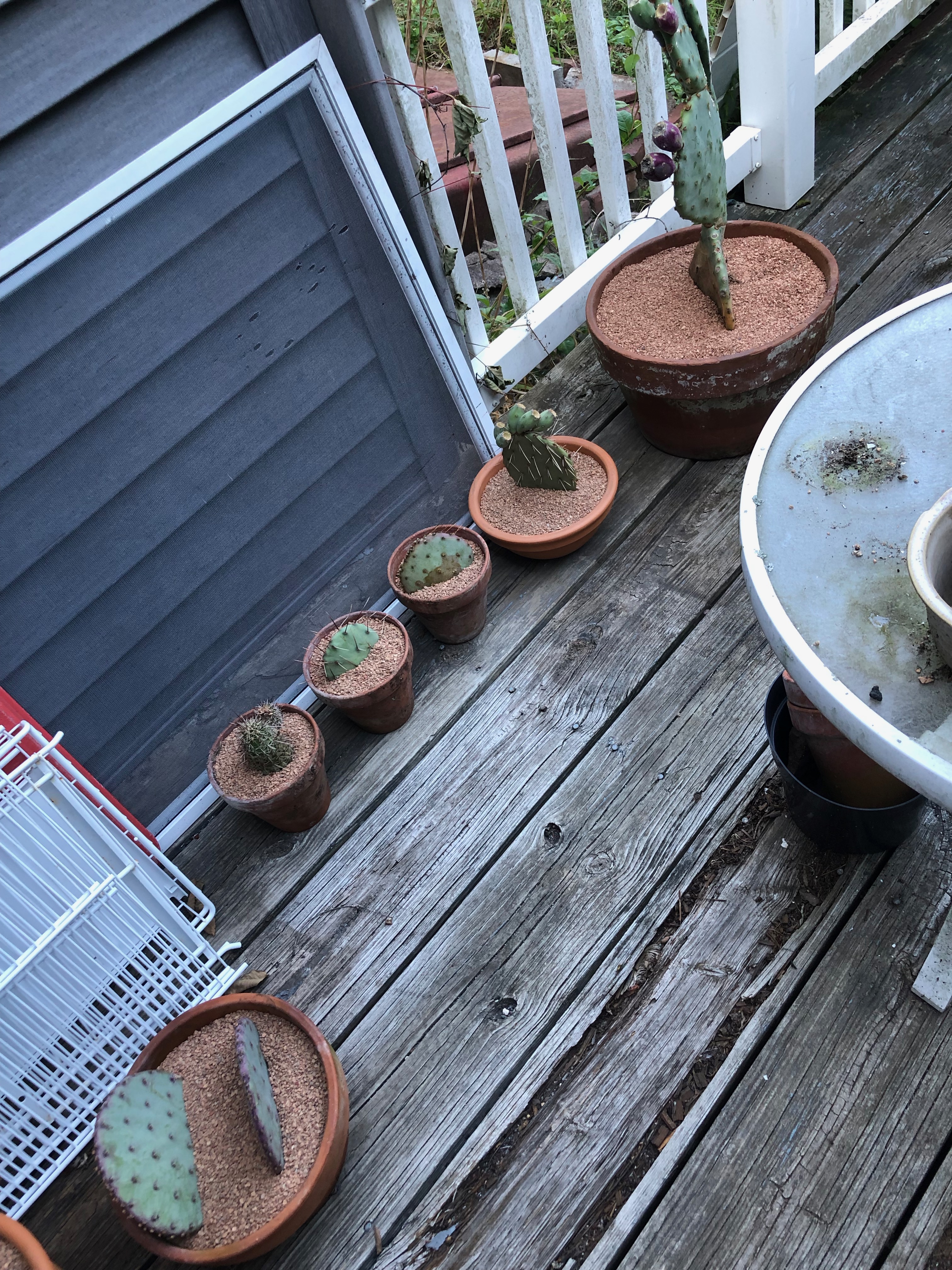
The above cactus in its new pot in CT

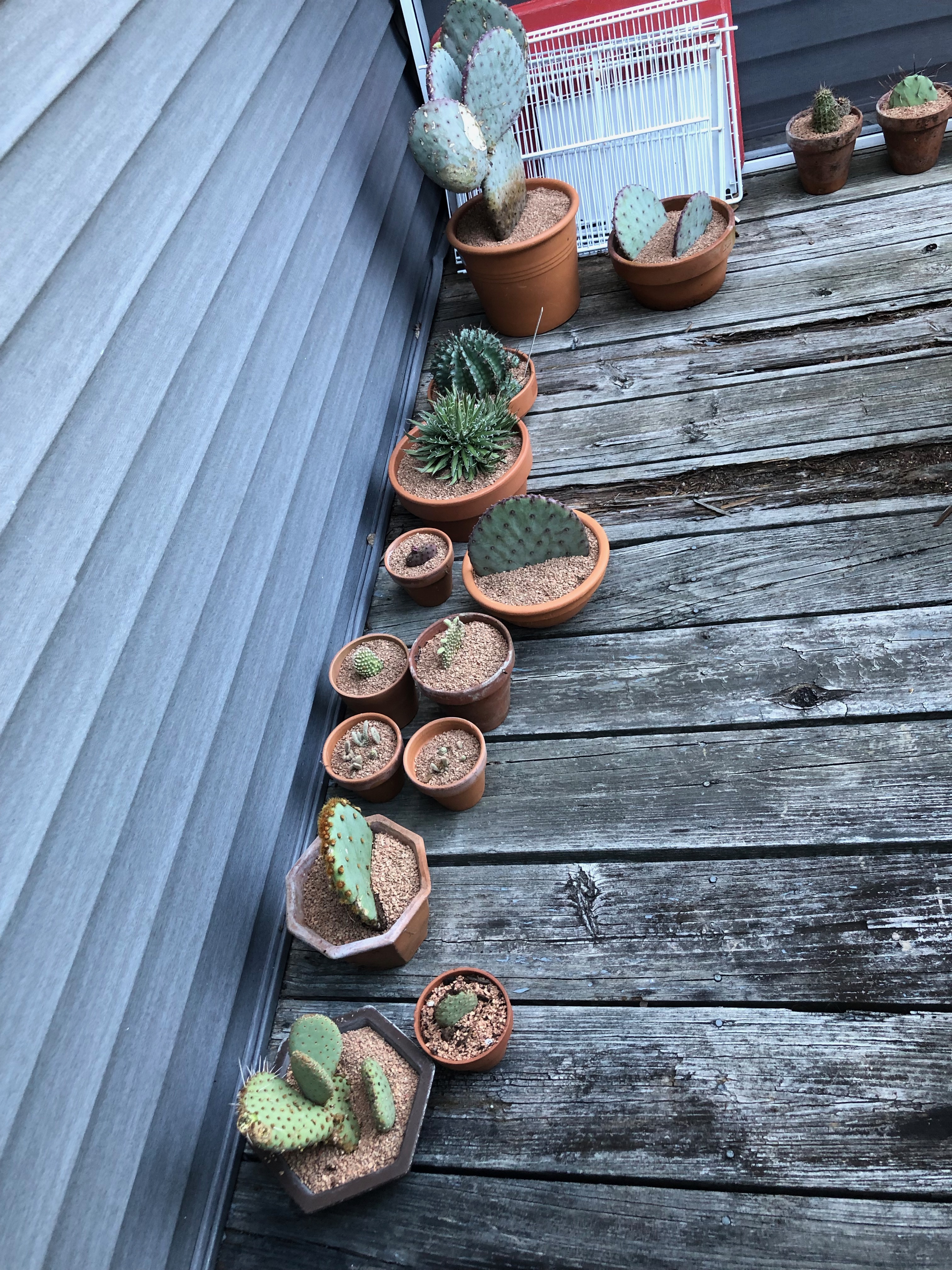
Other cacti we brought home

Other cacti we brought home