Articles of interest

Tuesday, September 13, 2022

Britain Must Confront Its Colonial Past

It’s been a few days now since Queen Elizabeth II died, although her funeral hasn’t been held yet. That will be on Sept. 19. 
 
It hasn’t taken long for multiple editorials to appear in newspapers online about the significance of her death. Not the outpouring of love from at least some of the British public. The other significance.
 
I hope my British friends will take this not as a criticism but as a hopeful perspective. I love Britain. Most of my ancestry is British. I've been there twice and would jump at the chance to go there again.
 
I surely sympathize with the royal family and wish them the best as they grieve privately and publicly, and for the people of Britain as well. They have lost someone who was a steady presence for three quarters of a century. 

Some could say that the US must look at its own violent past and leave Britain alone. But here's the problem. We're a part of their violent past, with the sanctioned institution of slavery, the conquest of a continent and the brutal genocide visited on the peoples who already lived here. We can't look at Britain's colonial past without looking at our own, and vice versa.

It can’t be forgotten that Elizabeth became a queen when there was still a British Empire, even though a significant part, India, had become independent only a few years previous.

One word sticks out in the brief public statement that she made on her 21st birthday to serve her country for however long her life was. She referred to her “imperial” family. That’s the word.

Britain has lost two empires. We in the United States were much of the first. The second one began slipping away in the 40’s and is all but gone today.

As Elizabeth is remembered, her family is wrapped in traditional roles, probably somewhat comforting in its predictability. The pageantry is everywhere. The emphasis is on tradition and Britain’s heritage.

But which one? King Arthur, Henry VIII, Shakespeare and tea, or the excesses of empire?

Bear in mind that I have a great love for Britain and their people. If I had to live somewhere other than New England it would be Britain. But I have to be honest to myself about the colonial heritage.

England started to flex its colonial muscle during the reign of Elizabeth I in the second half of the 16th century. First to feel the might of the rumbles of empire was Ireland. Bear in mind that England was obsessed with Ireland for some time before Elizabeth, but under her reign the colonization of Ireland happened. The tensions in Northern Ireland between Catholic and Protestant are a direct result of this colonization. The Protestants were the wealthy landowners and the Catholics were their workers.

England next turned its collective eye to the newly discovered New World, although they were hardly alone in that. For a century and a half England dominated the eastern half of North America. After 1776 we know how that went. George III never got over it. BTW George was Elizabeth’s 4 gr. grandfather. She knew that. She seemed to have gotten over the loss of their first empire, having made numerous trips to the US. And why not? I was always glad to see her come.

The remnants of the first empire in the New World continued in the sugar plantations of the Caribbean, which kept slave traders in business until the slave trade was abolished in 1807. The brutality of the sugar industry was beyond description. The average survival of an enslaved worker was no more than a year or two before they were burned to death.

After Britain lost their first empire they turned east. The East India Company had been formed a long time before and they ruled India like one big happy plantation. Once the bottom fell out in the 1850’s the British government (under Queen Victoria) took direct control of the government of India. By that time Britain had taken countries all over the world. By that point they had given up on getting us back.

Africa and Asia were a major focus as well as the Pacific Islands. Where they couldn’t control directly they controlled indirectly, such in the Opium Wars during Victoria’s reign. They forced the opium trade on China to finance the tea trade. Nice.


I could go on about atrocities, such as the massacre at Jallianwala Bagh, also known as the Amritsar massacre, in 1919, when several hundred Indians were gunned down brutally during a protest. They couldn’t escape because they were in a closed courtyard. Books have been written about Britain’s racist, violent colonial occupation of many countries.

No, none of that was Elizabeth’s fault. She inherited the legacy, though. She reigned through the dismemberment of the empire and created the Commonwealth, sort of an empire lite, without the military presence.

But Elizabeth is dead, and her sometimes cranky son Charles has become King Charles III. He has a tall order. In the short term, being a steady presence as Britain navigates their self-imposed post-Brexit hangover. Long term, he needs to help create a new Britain based not on the tired old empire of the past but on an island nation with an international profile. He needs to  publicly acknowledge the many sins of the imperial past and say that they aren’t going back there again. There was a hint of that in his first speech to the nation. Let’s hope he follows through.

Thursday, August 4, 2022

How to Pack a Cactus for Air Travel


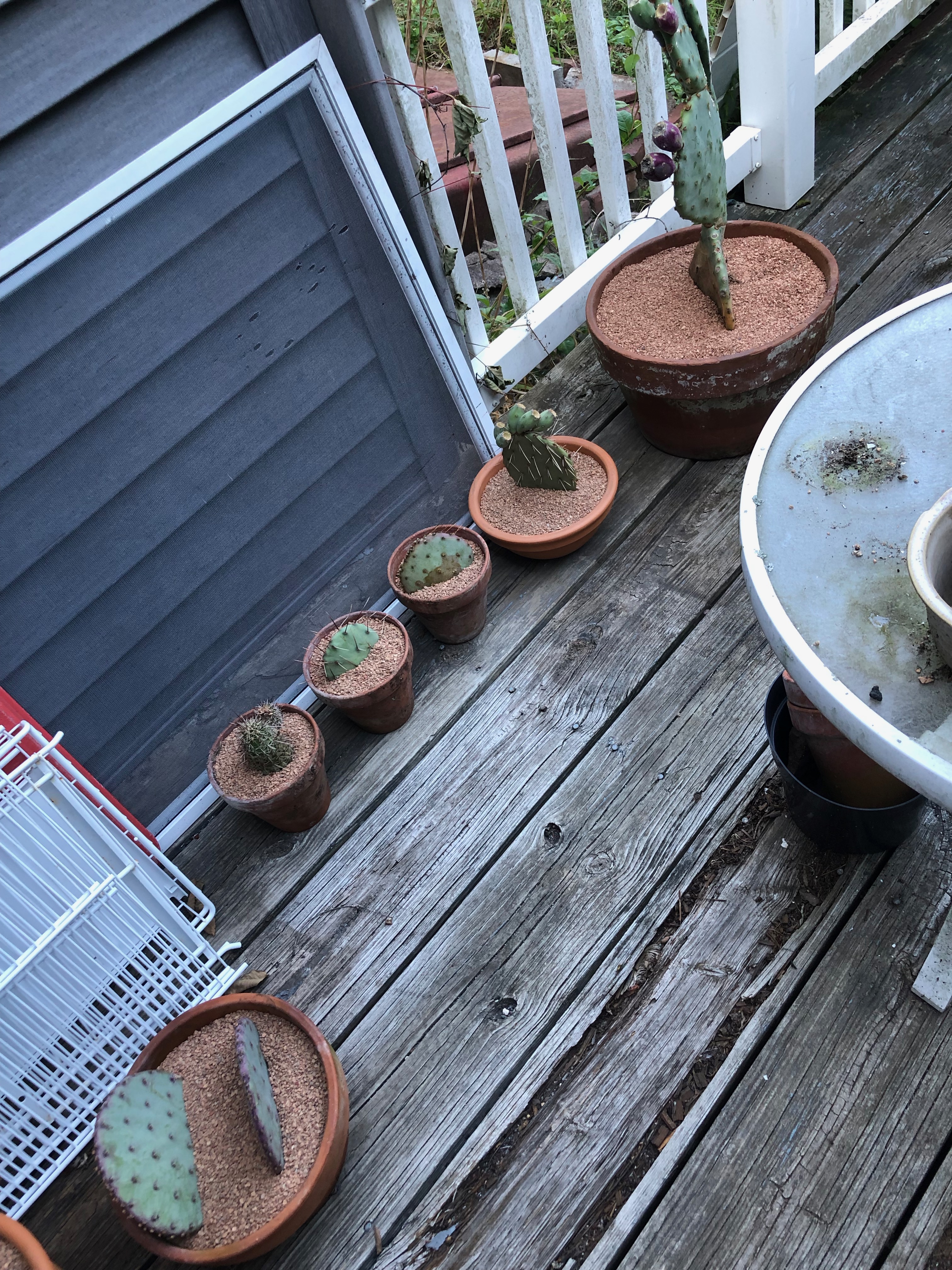
A large opuntia in its nursery pot.
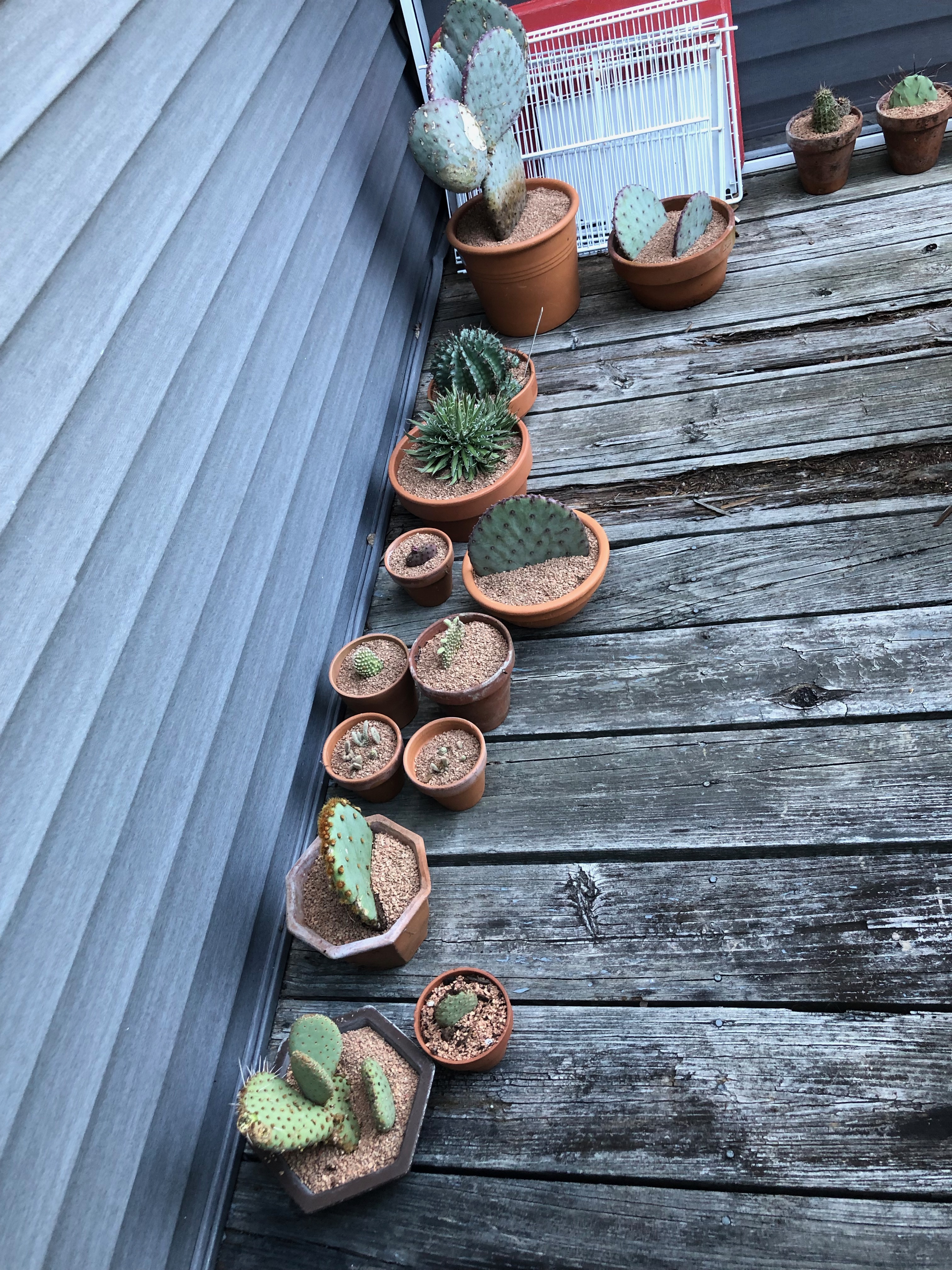
 My wife and I just returned from a family trip to Sedona, Arizona. Since we collect cacti and succulents we always hit a couple of nurseries between Phoenix and Sedona to find specimens that we can’t find in New England. This trip was a bonanza. We came back with several great succulents including a nice Euphorbia corrida and a couple of others. We also found several opuntia (prickly pear) and collected cuttings on the roadside, where various species of opuntia grow like weeds. 

Cacti are native to the Americas and are not found elsewhere. Succulents other than cacti are mostly native to Africa but some are found in the Middle East. The way to tell the difference is cacti have an areole (round feature on the surface) around each needle. Succulents often have needles but no areole. If you're not sure check the label or ask someone at the nursery.


The question we always get is “how are you going to get them back home?” That’s what this post is about.

First, the cactus must be bare rooted. Note that you can substitute “succulent” for “cactus” anywhere here.

Be sure to wear gloves at all times.
The root ball often is not very large.

Always have a supervisor.


A cautionary word before proceeding: all cacti have needles or spikes. They also have what appear to be hairy spots. An opuntia is the best example of this. The “hairy” spots are placed regularly all over each “ear” of the cactus. But here’s the thing. They aren’t hairy. They’re tiny needles that will quickly get into your skin and are almost impossible to get out. Once they’re in there you might be able to pull them out by applying duct tape to the affected area and pulling it off quickly but that doesn’t work. The solution is to wear the heaviest gloves you can find. Welding gloves are good, as well as thick leather gardening gloves. You will probably still get stuck but not nearly as much.


Bare rooting is perfectly safe for the cactus because it is also a succulent and is basically a sponge. Knocking off most of the soil will greatly reduce the bulk of the pant as well as the weigh, which is significant. Once you knock off the initial amount soil you can massage the roots to get off more.

Sometimes with an opuntia you will need to twist off some of the upper ears because they are floppy or feel loose. Don't do it automatically. We did this with one. The cactus will grow new ones, and each ear will become a new cactus.


Once the soil is off, wrap the root ball fairly tightly. If it is small you can use a ziplock baggie. 1 or 2 gallons is generally ok.


Then wrap the body of the plant with cardboard then stretch wrap it in place. Then stretch wrap the whole thing. You’re done!

Wrap the body of the plant in cardboard.


The soil removed from several cacti. We didn't have to ship it!


Packing is important. We used a large moving box that is within the dimensions specified by the airline. In this case the requirement was that the package be less than 62” for combined height, length, and width. It also needed to be less than 50 pounds in weight. Use lightweight packing material such as empty water bottles to serve as air pillows, bubble wrap, or something that won’t add to the weight.

Seal the box and put your address and phone number on the top in case the box gets separated from your other checked luggage. On several sides including the top write “Fragile: Live plants” or something to that effect. On the vertical sides draw a big arrow pointing up to indicate the direction in which the box should be oriented.

You won’t be able to take the box as a carry on. You will need to check it. Be sure to ask at the curbside check in that they put a “fragile” sticker on it.

When you get home unpack the bus as soon as possible and pot up the cactus and enjoy! Be sure to keep your cacti and succulent outside until the temperatures start go go below 50 at night. When the temperature drops bring them inside and place in a sunny area. DO NOT WATER your cacti during the winter. They will be fine. They will go into dormancy and do not need water. Succulents are ok once a month for water when inside.

 A word about repotting: use Turface MVP for your soil. You can often get it at landscaping companies. You can search online to find a dealer who carries it in your area. It comes in 40 lb. bags. It is crushed dry clay. It retains some moisture but freely drains water. Don't water a repotted cutting (one without roots) for a few weeks. If you do it won't be able to absorb the water and may rot.

 In New England you shouldn't water a cactus more than once a week. If it rains sometime that week don't water. If your local forecast indicates several days of rain cover your cactus with plastic. Too much water might induce rot. Remember that the native environment of a cactus is an arid environment, or even a desert. Think of the body of the cactus as a sponge. It's already full of water. 

Casualties of our packing: two small ears came off a smaller opuntia. Everything else was fine.


The above cactus in its new pot in CT

Other cacti we brought home

Other cacti we brought home


Thursday, April 28, 2022

National Debt and Economic Woes in Czarist Russia

Here's my next installment on history told through postage stamps and other paper ephemera including paper money and revenue stamps. All examples are in my collection unless otherwise noted. Today I'll look at the foundation for the economic problems near the end of the empire.

Monetary problems plagued the Russian economy before and after the Revolutions of 1917. Much of it stems from the Russo-Japanese War of 1904-5 and World War I. The czarist government could only keep itself afloat by constantly borrowing money. In this post you'll see examples of the bonds they issued to raise money. In effect, what they were doing was running the country and the war effort on a credit card that had no limits. And, as with modern credit cards, periodically they had to pay some of the money back with interest. 

Under Nicholas II (and previous to him) the ruble was relatively stable, being backed by gold. In other words, you could exchange paper money for gold coinage, and the treasury only issued rubles to match the gold they had on hand. There was gradual inflation but it was manageable.

1898-1915 one ruble bank note

 There's debate over whether Czarist Russia's tax policy was to keep the taxes paid by the nobility low and the rest high. It seems likely that that was the plan. Taxes were not just set to provide the government with revenue.

1902 vodka tax stamp
Some taxes, and the products that were taxed, had huge social consequences. The vodka tax was probably the most significant. Since the 18th century the government had a monopoly on the sale of vodka. An earlier version of the state store. Alcohol consumption was and still is a serious health concern in Russia. Until the 1880’s vodka was bought by the bucket. Vodka sales and the tax revenue sales generated amounted to roughly one third of all government revenue.

When Nicholas II banned vodka sales in 1914, so that his soldiers wouldn't drink on duty, that third of government revenue evaporated. This doesn't mean that people stopped drinking. They made their own, and the government didn't benefit from the sales.

In an earlier post I noted that the Russo-Japanese war was disastrous for Russia in three ways--economically, socially, and militarily. Militarily, they didn't have the infrastructure in place to get their troops to the front in a timely manner. They lost in a big way, cutting their losses with a peace brokered by US President Theodore Roosevelt. Economically, the country was plunged further into debt. The war resulted in huge losses of military equipment. A large number of naval vessels was lost as well as other equipment. Socially, around 400,000 soldiers and sailors were killed, making the war unpopular. The 1905 Winter Palace massacre came on the heels of the end of the war as people were desperate for relief.

File:Russian poster WWI 081.jpg
1917 Russian war bond poster (Wikipedia)

The debts from this war were still current when the country entered another war unprepared. The Treasury issued various sorts of bonds to support the government and the war effort. Just as in other countries the government tried to drum up sales of war bonds. The bonds were also floated in various countries, notably France, Britain, and the United States.

Between 1915 and 1917 the government borrowed 8,000,000,000 rubles to fund the war effort. That's right. Billion with a B.

By 1915 the economy in Russia had tanked and regions were experiencing periodic famines. Coins disappeared from circulation as people hoarded money. The government was forced to resort to printing more paper money, including small denominations to replace coinage.

1916 2 kopek bank note


At first the government tried printing stamp money using the plates from a 1913 commemorative stamp set celebrating the 300th anniversary of the Romanov dynasty. They printed the images on thin cardboard with a notice on the back that this was indeed real money.

1915 20 kopek stamp money

Of course, all this came crashing to the ground when the two phases of the Russian Revolution happened in 1917.

Sunday, March 27, 2022

Another War Russia Provoked That Didn’t Go Well

Nicholas II on a 1913 stamp

 
A Russian stamp from around 1905


Under Czar Nicholas II Russia had a tendency to get into wars that really didn’t go well. The two notable ones are the Russo-Japanese War (1904-1905) and World War I (1914-1918). Both contributed significantly to the fall of the Romanovs in 1917.

In the later 19th century Russia was working on getting a tighter grip on the far eastern part of the empire in Siberia. It wasn’t just to have a handy place to send troublemakers.

Since 1897 Russia had leased the Chinese port of Port Arthur, on a peninsula east of Beijing in northeastern China. It is also very close to the Korean Peninsula. Since the 1894-95 war between China and Japan, Japan was very nervous about Russian attempts to expand into Manchuria and the Korean Peninsula. As a result, Japan declared war on Russia in November, 1904.


The Meiji Emperor in 1896

Japan had been on a long-term program to become a modern industrialized nation and a military power. Access to Japan by the West had only opened in 1853 and some interest in the West began. With the accession of the Meiji Emperor in 1868 the shogun era ended and Japan launched upon their modernization. By the 1890’s they were a significant power in Asia, much more powerful than the aging, crumbling Chinese Empire.


Theodore Roosevelt, 1922 US stamp
Russia’s access to a warm water port has always been an obsession. Their northern coast is open only a few months of the year and is otherwise locked in by ice. Of course, with climate change that may change significantly.

Russia sent its Baltic fleet in November, 1904 to engage the Japanese. Sending troops via the Trans-Siberian Railroad was not possible because it wasn't finished. Oops. This was no small effort, as the British government refused the Russian fleet passage through the Suez Canal. This meant that the fleet had to sail nearly halfway around the world, all the way around Africa to Manchuria.

The war did not go well. Port Arthur was captured, more than half of the Russian fleet was destroyed, and 400,000 Russian casualties resulted.

The war nearly bankrupted the Russian government. This was another example of the incompetence of Nicholas II who assumed, naturally, that God was on the side of Russia. Personally he hated the Japanese, probably stemming from an attempt on his life by a Japanese citizen before he was Czar. His views of the Japanese were patently racist by today’s standards.
1909 Russian bond


The war didn’t seem to be going anywhere, and the US President at the time, Theodore Roosevelt, stepped in. He invited leaders of the two countries to the naval base in Portsmouth, New Hampshire to negotiate an end to the war. He then left.for his home on Long Island to let them work it out. The result was Korea was recognized as an independent kingdom although it was soon annexed by Japan. This was the first time an Asian nation defeated a European power in war.

After the war Russia borrowed millions of rubles to pay for the debt that nearly bankrupted the country. In 1909 they issued a bond of 525,000,000 rubles, a staggering amount at the time. In today's dollars this would be $8.1 billion dollars. I have one of the bonds from this issue. The dividends were paid up to the end of 1918 but the coupons for the last two payments are still with the certificate. This is because the Bolshevik government cancelled all of the debt from the Czarist era.

Starting with the Crimean War in 1854-56 Russia has had a history of entering wars that went badly. Ukraine is just one example. Tragically, many people are dying because of this folly.


Friday, March 25, 2022

European Borders are Never Permanent: Poland and Lithuania

With Poland and the Balkans perilously close to the ongoing Russian war against Ukraine I thought it would be interesting to look at the changes in the borders in this region. It has changed significantly. Eastern Europe, partly because of the periodic shifts in borders of states the region has a very complex ethnic makeup that makes drawing borders perilously difficult. 

1921 Polish stamp

Poland and Lithuania are good examples of countries whose borders have changed significantly.  The Polish-Lithuanian Commonwealth was a very large kingdom that extended well into today’s Ukraine and Russia. It was at its height in the early 17th century. As the kingdom weakened it was partitioned between 1772 and 1795 to the point that it did not exist as an independent nation. It remained this way until the Peace Conference of 1919 which reestablished Poland and Lithuania as independent nations.


https://upload.wikimedia.org/wikipedia/commons/9/9a/Rzeczpospolita_Central_Lithuania.png
Republic of Central Lithuania (green) Poland (beige) Lithuania (gray) East Prussia (orange) Wikipedia

However, there was disputed territory between the two countries. In the northern section of the reconstituted Poland that bordered Lithuania a client state was formed that lasted barely two years (1920-1922) — the Republic of Central Lithuania. Although it was recognized by the League of Nations it was not recognized by Lithuania. Because the republic included the historic capital of Vilnius, Lithuania claimed it as their own territory. The short-lived republic was absorbed into Poland in 1922

Republic of Central Lithuania stamp, 1921
1923 Lithuanian stamp


But wait. There’s more. After World War II Poland’s borders were shifted several hundred miles to the west. The eastern part went to Ukraine and Belarus in the USSR. Lithuania gained what had been the Republic of Central Lithuania but by that point it was a part of the Soviet Union and no longer independent. Poland was given East Prussia when Germany was carved up. What was the free city of Danzig become GdaÅ„sk.

Confused yet? You should be. But imagine how confused the people who lived in that region felt!

Wednesday, March 23, 2022

European Borders are Never Permanent--The Papal States


3 Centissimi
 Some thoughts today on how postage stamps can tell the story of how modern nation states were built.

The stamps in this blog are a set from the Roman or Papal States, issued in 1867. I’ve always enjoyed them for their simplicity and their age. Each one shows a different design with the same theme, the papal crown and the keys of St. Peter. This set is part of my parents’ collection.


2 Centissimi

5 Centissimi

20 Centissimi
10 Centissimi
80 Centissimi


40 Centissimi


From the early Middle Ages the Papacy ruled the central region of Italy around Rome. This became solidified in the later Middle Ages (see the map--the Papal States are in purple). During the Middle Ages and the Renaissance the Papacy not only governed the church but ruled this section of the Italian peninsula. The Pope had an army, and on a number of occasions engaged in war against another of the Italian city states. Italy was almost in a constant state of war with one city state fighting with another or territory or resources. This subsided once the Renaissance came to an end.


www.quora.com
https://upload.wikimedia.org/wikipedia/commons/3/3a/Giuseppe_Garibaldi_%281866%29.jpg

Giuseppe Garibaldi (1807-1882)

The medieval division of Italy began to end during the Napoleonic era. Napoleon ended the Venetian Empire and consolidated some of the fractured territories. By the 1840's the Young Italy movement arose with the goal of unifying the whole peninsula in a modern state. The leader of this effort was the military leader Giuseppe Garibaldi (1807-1882) who fought tirelessly to achieve this goal. The unified Kingdom of Italy was established in 1861. The Papal States were the holdout. Although significantly reduced in territory the papacy held on to its remaining territory until 1870. The Vatican formally renounced its claim to the Papal States in 1920 and the modern Vatican City, embedded in the heart of Rome around St. Peter's Basilica, was created.

As we look at the map of the world right now it easy to think that the borders of present nations have always been the same and won't change. In many cases that is probably true although not certain. With the current war in Ukraine we may see a change in borders. All wars end when an end is negotiated. Will Ukraine formally cede the Crimea to Russia? Will it recognize the two eastern breakaway republics of Donetsk and Luhansk, which if recognized would quickly be absorbed into Russia?

We don't know. In Europe, at least, the rule about borders is that they are never permanent. The last great redrawing of borders was in the late 1980's-early 90's when the Soviet Union broke up and all the former republics became independent. The breakup of Yugoslavia followed with the creation of new states.

The stamps above came from a time when the Papal States could see the handwriting on the wall. Their end was near. They ceased to exist only three years later, and Italy and the papacy were changed forever. At least for now.


Monday, March 21, 2022

Lenin


 I decided that Lenin required a separate post. Like everyone else in Russian history, he’s complicated. He was born in 1870 to an upper middle class family and had, from the sound of it, an average upbringing. The turning point in his life was in 1887, when his older brother Alexander was executed for his participation in a plot to assassinate Czar Alexander III on the sixth anniversary of the assassination of his father, Alexander II. Vladmir Ilyich Ulyanov (his real name) turned to Socialist ideas in his desire to reform society to free the working class and peasantry from oppression. This would mean, in his view, the overthrow of the monarchy and of the nobility, and the unbridled capitalist system that legitimized them.

Lenin studied political thought, especially Marx, and developed his own philosophy based on that of Marx. In order for the revolution to succeed it needed an elite to lead it. The masses, he thought, would not overthrow oppression without strong leadership. After earning a law degree he married and moved to western Europe, living in several different countries, and continued to develop his political philosophy.

As a person, Lenin was very intense, and saw the world in black and white. There were no nuances. He was always right, and anyone who disagreed with him was wrong. This stark contrast continued once he came into power and fated many thousands to die in prison camps. If you spoke up because you disagreed with the party line you risked becoming disappeared.

Lenin had contacts in Russia and continued to monitor the political situation closely. For years he did not think that the revolution would come in his lifetime but he hoped it would.  When the country continued to unravel at a faster pace as World War I continued, it became more of a possibility that the revolution would come. When it finally came in late February, 1917 he made plans to return to Russia. He approached the German government from his home in Zurich, Switzerland and asked that he be allowed to travel by train through Germany. The German government granted his request knowing full well that he intended to foment revolution, and that a revolution would probably result in Russia’s withdrawal from the war. As it turns out, that is exactly what happened. Lenin arrived in April and was greeted as a conquering hero.

https://socialism.com
Left: 1920 Soviet poster: “Comrade Lenin Sweeps the Globe Clean” by artists Mikhail Cheremnykh and Victor Deni.

Lenin continued to work, giving speeches and helping to organize. When the time came to overthrow the provisional government he was ready with organization.

Once in power, Lenin continued to verbalize the ideals of the revolution on behalf of the people, but it soon became clear that he was intent on purging Russian society is of people who disagreed with the ideals of the revolution. He sent thousands to prison camps on very little evidence.

There are differing opinions on what brought about his death in 1924. It is factual that he had a series of strokes in 1923-1924 that left him increasingly disabled, the last one making it impossible for him to speak. The last photographs of him depict a shattered, crushed individual, blankly staring into the camera from his wheelchair. Some theorize that syphilis caused the strokes and his decline, and others assert that stress and his intense personality brought it about. He was clearly an energetic person with enormous energy, and a very forceful public speaker. I write that with trepidation. I have no admiration for him as a leader or a person.

The cult of Lenin started in 1918. On August 30, 1918 a disillusioned Bolshevik shot Lenin. He survived but carried a bullet for a few years. His survival started a cult surrounding his immortality. He didn't like it and tried to suppress it but to no avail.

The 6 kopek memorial stamp. 
He died on January 21, 1924 after a series of strokes that left him increasingly immobilized. On the day of his funeral a series of four imperforate stamps were issued, which were later issued in perforate form. Generally, an imperforate issue is easier to produce since it doesn't have to go through the extra stage of having the perforations applied. It could be produced in shorter time. The engraving design was probably already ready since those in the know knew that his death was immanent.

After his death in 1924 the party (probably not many Russians outside the party, however) mourned his death. A few memorial stamps were issued, another of which you see below from 1926. They’re typical memorial stamps from pretty much anywhere. Sometime in the 1930’s Lenin was deified, and an official cult developed around him. His body, which had been embalmed and put on public display was installed in a stone mausoleum just out side the Kremlin walls, where it still remains after nearly a century. Until the fall of the Soviet Union photographs were not allowed, but they are now. Estimates are that much of what you see now is wax rather than Lenin.

Lenin became a deity. He constantly appeared on postage stamps, posters, and in every form of public media available. A series of lavish commemorative postage stamps was issued every year on his birthday. Typical depictions showed him speaking from a podium, or in a state of deep thought. As time went on it became common to depict important scenes in his life, and various stages of his youth. I have often thought that these depictions strongly resembled Sunday school depictions of Jesus. Jesus healing people. Jesus teaching people. Jesus at prayer. Perhaps these images were based on Russian Orthodox iconography. I wouldn’t be surprised.

1970 was a big year for Lenin worship because it was the centenary of his birth. He was everywhere, perhaps even more so than normal.

For the most part the later images of Lenin are hagiographical and predictable.  After a point they were all the same.

When Anita and I and my younger son visited my daughter while she was in Ukraine in the Peace Corps about fifteen years ago we went to see the Lenin statue. It was high up on a pedestal. The larger than life figure was pointing dramatically to the sky as if leading the charge into the future. I asked her why they hadn’t removed the statue. She said that it was too expensive, and that now people just ignored it.

I really wanted a Soviet era depiction of Lenin--a Lenin "Mini Me"--and found one in an outdoor flea market in Kiev. It’s the kind of small bust that would have appeared in people’s homes, on desks at work, etc.

Lenin has been relegated to Karl Marx’s “dustbin of history.” Thankfully. He was a monster.

My Lenin "Mini Me"


1970 commemorative Lenin ruble.