Articles of interest

Saturday, March 19, 2022

The Fall of the Romanovs and Ramifications, Part II

 The provisional governments that took power after Nicholas II's abdication on March 2, 1917 weren't able to hold on to the government. The forces at work were simply to difficult to withstand. With the country still in turmoil, the Bolshevik movement became a steamroller. On October 28 they stormed the Winter Palace in St. Petersburg and seize control of power from the Provisional Government. Soviets were set up in municipalities across the crumbling empire. A soviet was a party committee.

The imagery of early Soviet stamps is bold. Take a look at this issue from 1918 with a hand holding a sword breaking a chain. This is obviously an idealistic image, and the stamps from this time are definitely idealistic. As time went on, though, things were not going the way that many had expected. Dissenters from the Bolshevik philosophy were rounded up and often executed without trial. The revolution that had claimed to be in the best interest of the people now became just another repressive regime.

Economically, things were generally good for awhile. In March, 1918 Lenin signed the Treaty of Brest-Litovsk with Germany to pull out of the war. As a part of the treaty Russia recognized the independence of Ukraine, Georgia, and Finland; gave up Poland and the Baltic states of Lithuania, Latvia and Estonia to Germany and Austria-Hungary; and ceded smaller territories to Turkey.

Finland had been a part of the Russian empire since 1809. It had already declared independence from Russia on December 6, 1917. While a part of the Russian empire Russian stamps were used there such as the one on the left, below.

Russian style stamp for Finland, 1911
   
One of the first Finnish stamps, 1918

From 1918-1920 a group of Russian armies in the northern part of Russia attempted to overthrow the Bolshevik revolution. This was during the period of 1917-1923, collectively known as the Russian Civil War. Known as the White Army or the Army of the North, this movement was never able to succeed because of lack of recruits and general disorganization. It was eventually defeated in 1920 by the Red Army. They were able to set up their own postal system with stamps, however.
Two stamps from the White Army, 1918-1920
Relatively speaking the stamps for the White Army were crude, but they served the purpose.

Stamp from the North West Army, 1919-20
 Another White Army, the North West Army, was active in the Baltic region. They too fell apart from disorganization but had their own postal system. Their stamps were of about the same quality as the Army of the North (White Army). It may seem that postage stamps would not be a priority but it is important to remember that a postal system was essential to the morale of an army. They had no other way of communication.

Economic conditions began to deteriorate in Russia in 1920. By 1921 a famine took hold in parts of Russia and Ukraine. During this time the government resorted to overstamping old czarist era stamps to save money. In the last post I offered a picture of a 1889 50 kopek issue. The same stamp and many others were marked with the sickle and hammer and a new value.


As I mentioned above, the early stamps of Bolshevik Russia are very bold in nature. Some bear the inescapable signs of hyperinflation, as does the stamp below.


250 ruble stamp, 1921
 

250 ruble stamp with 7500 ruble overstamp, 1922
 
250 ruble stamp with 100,000 ruble overstamp, late 1922

 Given the harsh economic conditions the Bolshevik government still celebrated the fifth anniversary of the 1917 revolution.

Conditions in Ukraine were especially bad. In 1923 Ukraine, shortly before it was absorbed into the newly formed Soviet Union, issued four semi-postal stamps to raise money for victims of the famine. A semi-postal stamp is one that adds a surcharge to raise money for a particular cause. They have been popular in Europe since the nineteenth century. Only a very few have been issued in the United States. The stark image of this stamp with the farmer wresting a sickle from the hands of death is a graphic reminder of the suffering experienced during this time.


In Part 3, we'll look at Lenin.


The Fall of the Romanovs Part 1

 Russian history is always complicated. In the Middle Ages it was a small kingdom of Vikings centered in Kyiv. Gradually it spread to include the area ruled by Moscow. By the mid 16th century the center of power had shifted to Moscow. Under the Grand Prince Ivan IV (known as "Ivan the Terrible") the power of Muscovy continued to grow. Ivan was proclaimed the first Tsar and ruled until 1575.

After that time Russia expanded its territory to create a large empire. By the time of Peter the Great (r. 1682-1725) and Catherine the Great (r. 1762-1796) Russia had expanded considerably. The Romanovs had ruled Russia since 1613 under Michael I. Russia remained a feudal empire, essentially, not freeing the serfs until 1861 under Alexander II. Despite this, the vast majority of Russia's population lived in grinding poverty while the nobility and royalty lived in splendor.

Then we come to Nicholas II. He has become a poster child for royal incompetence, and deserves every bit of it. Nicholas and his family lived in isolated splendor with palaces, beautiful clothing, and fancy food. Prior to Nicholas' reign, unrest had begun in Russia by 1825 with the Decembrist revolt. As the 19th century progressed there seemed to be little change other than the freeing of the serfs.That was significant  but it did not effectively improve the economic hopes of former serfs. Poverty still reigned supreme.

Mahatma Gandhi famously said that "poverty is the worst form of violence" and 19th century Russia is a classic example of that. Socialist groups became active as time went on. This came to a head on March 13, 1881 when a Socialist group called the "People's Will" assassinated Tsar Alexander II by throwing a bomb into his carriage in St. Petersburg. Among those implicated in the assassination was Aleksandr Ulyanov, who was executed for his participation. His brother, who came to be known as Vladimir Lenin, rose to prominence later.

Czarist Russia presented itself as an enlightened empire. The nobility had relatives and contacts all over Europe and they lived on large estates farmed by large numbers of laborers. It was very much an agricultural society.

The stamp above, from 1889, typified the postal imagery of the time. This sort of general image, proudly displaying the Russian double-headed eagle, presented an imagery of stability and of empire. As the 19th century progressed nothing could have been further from the truth.

Peter the Great, 1913 commemorative issue
Nicholas II came to the throne after his father, Alexander III died in 1894 at the age of 49. Nicholas came to the throne at the age of 26, completely unprepared to rule such a vast empire. He soon married his first cousin Alexandra, another grandchild of Queen Victoria of England.

Nicholas resisted all efforts on the part of his government to modernize Russia. He grudgingly allowed for the formation of an elected Duma ("house") after the 1905 Winter Palace massacre. His usual tactic was to try to repress political dissidence with military force.

In 1913 the Romanovs celebrated three centuries on the throne, with lavish balls, church services and other commemorative activities. Russia also issued a set of stamps depicting notable Romanov rulers including Peter the Great, Catherine the Great, and of course, Nicholas II.

Catherine the Great, 1913 commemorative issue

  
Nicholas II 1913 commemorative issue


I'm sure that the vast majority of Russians were not impressed with the lavish celebrations of a family that kept them in poverty. The family also hid a catastrophic secret. Their son, Alexis, was a hemophiliac. Hemophilia is passed down through mothers to their sons, and Victoria's family was rife with it. At that time hemophilia was a death sentence. They tried all sorts of medical treatments and eventually latched on to a classic social climber, Grigori Rasputin. I don't have a stamp for him. There aren't any. Rasputin mesmerized the family with his repeated healings of Alexis from 1907-1916. During his ten years of influence Rasputin drank and caroused his way through Russian high society. By 1916 the nobility had had enough and he was killed by members of the Romanov family.

Concurrent with Rasputin's grip on the Romanovs, Russia's participation in World War I was disastrous. Failure after failure led Nicholas to decide to command the army himself. He traveled by train to be nearer the troops. This couldn't have been a more incompetent decision, for he left his even more incompetent wife, Alexandra, in charge of the government.

Conditions in Russia deteriorated and inflation set in, illustrated by the 1913 stamp depicting Nicholas overstamped with ten kopeks over seven. Inflation like this is never a good sign and is often the beginning of the end.

With the war taking millions of soldiers' lives and starvation setting in, the Russian people had had enough. On February 28, 1917 the military in St. Petersburg refused to fight, and formed the Petrograd Soviet. On March 15 Nicholas abdicated the throne.

A provisional government was set up as a republic. The rest of 1917 was rocky, with several governments taking over in succession. This imperforate stamp from the first provisional government of 1917 is a reprint of a czarist era stamp. They reused old plates to save on expense and provide some semblance of postal services to the country.

Nicholas and his family were famously killed on July 17, 1918 in Yekaterinburg in Siberia.

In the next installment I'll look at the beginnings of the Soviet Union and the humanitarian catastrophe that followed.

As a postscript to this look at the fall of the Romanovs I wouldn't say that they deserved what happened to them. However, they brought it on themselves. At every turn Nicholas could have adapted and kept his throne. It's possible that with the assassination of Alexander II the country had already gone past any hope of a constitutional monarchy. We'll never know.

Nicholas was not a good ruler. He knew it, too. At his father’s death he lamented that he didn’t want to be Czar and that he had no idea what to do. However, convinced that God had destined him to be Czar he went ahead. He wasn’t a bad person but he was totally unfit for the task of ruling such an empire in a time of rapid change. He was easily swayed, to the point that one courtier quipped that the most important person in Russia was the most recent person Nicholas had spoken with.

With the empire seething with potential revolution Nicholas and his family continued their summers on the Crimea, yacht excursions on the Baltic Sea, and all the time, hiding the hemophilia of their son, Alexis. Nicholas knew that his son would not live to see twenty.

The 1905 Winter Palace demonstration should have been a wake up call. Had Nicholas embraced a constitutional monarchy he would have lived out his days as the ceremonial monarch of Russia. But, it didn’t happen that way. He wanted total control, and his total control led to his own demise. He grudgingly agreed to a Duma, or legislature, but he had the power to dismiss it whenever he wanted to and could veto anything they did. He dismissed it several times.
 

Lenin himself did not expect the overthrow of the Romanvs to happen during his lifetime but he was happy to jump on the wagon when the opportunity presented itself. More next time.


Friday, March 18, 2022

The Ageless Queen Victoria

The Penny Black, 1840


This is a story about image. First, the Penny Black, the first prepaid postage stamp in the world. The stamp was issued in 1840 and used only for a year when the Royal Mail people realized that the black color made it difficult to see the black cancellation. For awhile they switched to red cancellations. Then they switched to printing the stamp in red. 

 As the world's first prepaid adhesive postage stamp the Penny Black was a welcome innovation. Prior to that time the recipient of a letter had to pay for the postage which was calculated on the number of miles from its origin and the number of sheets of paper. With the introduction of postage stamps the volume of mail went up significantly. The Penny Black is still widely available to collectors. It's expensive as a single postage stamp but relatively affordable. Sometimes you can get lucky. I recently bought this copy in an eBay auction for the price of a nice lunch for two.

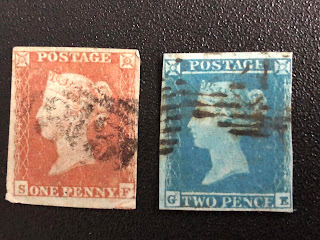
The Penny Red and Penny Blue stamps, 1841

 The Penny Red along with the Penny Blue (actually a 2 pence stamp) was originally imperforate, meaning it did not have perforations between each stamp so that an individual stamp could easily be torn from a sheet. Each stamp had to be cut from the sheet with scissors.

 In 1854 the Penny Red was issued with perforations so each stamp could be torn off the sheet. The problem with imperforate stamps was that if a person cut too hastily they might actually cut into the stamp next to it. You can actually find specimens with part of another stamp to one edge or another. 

The 1854 Penny Red


The next change was in the upper right and left corners. Stamp designers were always trying to stay one step ahead of counterfeiters and those who attempted to re-use stamps. One trick that enterprising people tried was to take two stamps, one with the cancellation on the top and one with the cancellation on the bottom. They would cut each stamp in half and put them together to make a composite stamp. This would only work as long as the stamp had Maltese crosses in the upper corners.  

The letters in the bottom corners indicated the stamp's position on the printing plate. The 1854 stamp to the left was in rank O and column L, for instance.


In 1861 the upper and left corners were changed to have the same letters as in the bottom corners, except they were reversed. This made it virtually impossible for someone to clip two stamps and make a composite one.


 The green stamp below is one of the two last stamps issued during Victoria’s reign in 1899. She was born in 1819 and reigned from 1837-1901. 63 years. In that time the same portrait was used on British stamps. No wonder the British thought she would live forever. She didn’t age a day if you took these images literally.


 The purple stamp below is from Canada about 1899 or so. This one has an honest portrait of her in old age. Interestingly, British coinage issued later in her reign showed her as older. Colonial stamps also depict her with a lot more variety than the stamps in Britain.  Coinage from Victoria's reign also shows a progression in her age, I've never seen any rationale given for the perpetuation of the youthful portrait. It wasn't used consistently in all contexts in which an image of the queen would be used. Perhaps the expense of engraving a new portrait was too much? I would expect that the engraving of a new design wouldn't be any more expensive than the production of a new coin.


Royalty, no matter when, have always relied on image. Queen Elizabeth I (r. 1558-1603) was famously obsessed with her public image to the extent that she had any depiction of her banned that did not show her as a young, vibrant woman. Later portraits of her depict her as younger, but they are stiff and do not look like portraits taken from life (which is something you could probably say about many English portraits from that time). There are a few remarkable survivors, though, showing Elizabeth as a tired, elderly woman. Victoria also changed with age, as we all do, becoming increasingly stout, something not difficult to do if you're only five feet tall.

I doubt that anyone in Britain was fooled by the eternally youthful picture of Queen Victoria on their stamps. Perhaps they saw this depiction of her as being of her spirit, which never aged. After Albert's death she appeared in public infrequently, although she remained actively engaged in the affairs of government.

In the end, of course, the perpetually youthful Victoria of the postage stamp died as we all do. So goes the world.


Saturday, January 8, 2022

How the Nineteenth Century Shaped Who We Are, Part Five, The Civil War (part two)

 The last time a civil war was fought in North America was the American Revolution. It was truly a civil war, with citizens rebelling against their government, both local and remote. The population was divided, with approximately one third against separation from Britain. Loyalists, as they were called, either served in Loyalist regiments and actively fought against the Continental forces, or they fled to Canada, sometimes returning after a century or more.

This civil war was different, however. Although the populations of the northern and southern states were hardly unified in their views on slavery and secession the war drew lines between regions, something that didn’t happen in the American Revolution.

The idea of secession had surged a couple of times previously. Near the end of the War of 1812 The Hartford Convention (December 1814-January 1815) met to air grievances about the conduct of the war. They also addressed the process for the admission of new states, but the main concern was the 1807 Embargo and the effect it had on the New England economy. Some ports such as Salem, Massachusetts never recovered fully. Secession was discussed but in the end didn’t go beyond discussion. The fact that it came up and was debated is in itself significant, however.

The second time secession came up in a big way was the Nullification Crisis of 1832-33. Tariffs on imported goods were imposed in 1828 and 1832. The state of South Carolina declared that the tariffs were null (ie not in effect) within their state. Secession was threatened under the leadership of John C. Calhoun. Eventually the federal government backed down and reduced the tariffs and the crisis was over. But, the specter of secession had been raised again.

This goes back to Shelby Foote’s comment about how the states saw themselves within the Union, as constituent parts. They still do, but there is a sense of unity that didn’t exist before the war.

The immediate cause for secession was the election of 1860. It is impossible to rehearse the political history of the country in the decades leading up to it. Suffice it to say that slavery was the elephant in the room in every political debate during that period. It dominated the admission of new states, the creation of territories, and the management of the economy. The compromises of 1820 and 1850 lowered the temperature for awhile but only added fuel to the fire in the long term. The issue of slavery and the admission of free vs. slave states came to a head with the bloody division of Kansas known as “Bleeding Kansas,” with two separate state governments in power at the same time.

Where was President James Buchanan? Doing the equivalent of Donald Trump’s watching tv during the January 6 insurrection. Nothing. He had already checked out.

After the election of 1860 Abraham Lincoln won by a minority. He wasn’t even on the ballot in a number of southern states. By February, 1860 seven states had seceded. Eleven in total seceded. The Confederate States of America was formed on February 4.

After the war the states were readmitted beginning in 1868 during Reconstruction, which lasted until 1877.

This is the most significant constitutional crisis the country ever faced. The process of admitting states was called into question. The definition of equality was called into question as well as the makeup of the voting franchise.

This is one way in which the nineteenth century shaped who we are. It raised the issues of voting and civil rights. It certainly didn’t resolve the issue but it put the issues in the public eye in a way that couldn’t be ignored any longer.


Tuesday, December 28, 2021

How the Nineteenth Century Shaped Who We are Now (Part five: The Civil War, part 1)

 It is impossible to encapsulate the American Civil War in one blog post. I will undoubtedly end up with two or three, maybe more, one of them a personal perspective. This war shaped every aspect of American life and still does today. It is essential to have a good working knowledge of the Civil War in order to understand the United States today.

To start with, the United States. Shelby Foote, the Southern author who has become somewhat out of favor lately, stated in the Ken Burns series “The Civil War” (itself somewhat dated in its assessment of Robert E Lee and his legacy) that before the war people said that “the United States ARE” but after the war they said “the United States IS.” His thought was that the war’s aftermath gave a sense of the unity of the nation that it didn’t have before.

How can I describe a war that took approximately 630,000 American lives on both sides? How? With a total population of 31 million that comes to two percent of the population. Put that into today’s population and you come up with a staggering 6.6 million people. The decisive Battle of Gettysburg, with 51,000 casualties on both sides, would amount to well over half a million losses in today's population. It is impossible to overstate the impact of this loss. Almost all families were touched by the war on either side. The phrase “the empty chair” became a common way of expressing the inexpressible loss of a loved one.

There’s no point in rehearsing the history of the war. I could fill the volume of our entire house floor to ceiling with books written about it and still need more space. What we can think about, however, is the major themes of the period and its lasting effects on our society today.

To start with, race.

African Americans at the time were overwhelmingly in slavery. A small percentage were not but most were. White Americans always made a connection between people of African descent and slavery. The two went together. The hypocrisy of the North was that we felt we were not culpable in slavery yet we were. Our textile mills churned out coarse cloth from southern cotton that was sent back down south to clothe slaves.  Lots of money was made. We won’t even talk about the money that was made in the slave trade in New England prior to the abolishment of the slave trade.

The war still affects views of race today. The stereotypes of black men as lazy and shiftless go back to the era of slavery when black men resisted their captivity by doing as little as possible and still getting by. It wasn’t laziness. It was resistance.

Black women have sometimes been stereotyped as being more sexually aggressive than black men. This is another view that goes back to the time of slavery. Black women in slavery were regularly subjected to rape by their overseers and masters. They weren’t looking for sex. They were brutally raped.

White Americans, especially in the South, felt that they were doing Africans and their descendants a favor by enslaving them by bringing them Christianity and civilization. The two were inseparable in their minds. They drew the line, however, at teaching them how to read. Frederick Douglass and countless other enslaved people violated state laws and societal conventions by secretly learning to read. Who would think that reading was a subversive activity?

People in the North had a range of views about slavery. Some felt it was justified. Some were uneasy about bringing up the subject when talking with people from the South. And, of course, a good many were adamantly opposed to it but had different solutions to the problem.

The South and the North had differently based economies. In the North, industry was more prominent. Still, most people lived in small towns and worked on farms, but in cities industry was king. Foundries turned out products in cast iron, railroads crisscrossed the landscape, and deep pockets financed new ventures. This was easily converted to war production once the war started. In the South, on the other hand, there was some industry in the cities, but not as much as in the North, and therefore it did not form as large a part of the economic base. The foundation of the economy was cotton, and that was by nature a rural enterprise, an enterprise that cost countless lives.

White Southern society saw itself as more genteel as the money grubbing North, of course if you looked the other way in reference to slavery.

Northerners were not exactly sure what to do with escaped slaves once the war started. They coined the term “contraband” to refer to them. Frederick Douglass agitated for years to allow for black regiments in the Union Army. It eventually happened although it was far from perfect. They were paid less and often did not see battle, instead doing hard labor such as building temporary roads and tearing up railroads. They saw battle to an extent, and this increased as the war went on and the supply of soldiers became strained.

I guess that’s enough for now. It’s complicated. More soon.


Sunday, March 14, 2021

How the Nineteenth Century Shaped Who We are Today: Part 4, the Industrial Revolution and Slavery

 The next obvious step in discussing the ways in which the nineteenth century shaped who we are today might seem to be the Civil War, having discussed slavery previously, but I will get to that later.

The next stop is the Industrial Revolution. With the improvements in textile machinery in Britain during the 18th century, the invention of the steam engine by James Watt, and the utilization of coal as a fuel to heat water and produce steam, it was inevitable that such improvements would eventually work their way to the colonies, later to become the United States.

During the eighteenth century and earlier products were made in small shops. For example, in my home town of Meriden, Connecticut, silversmiths worked in small shops to produce household items, and pewter shops making less expensive alternatives.

In 1793 Samuel Slater, a recent arrival from Britain, opened the first textile mill in the United States. He had worked in mills in Britain, and famously memorized the design of the machinery used to make cloth. He reproduced the machinery in his mill and started what was to become the Industrial Revolution in the United States. In the very early 19th century textile mills were established in Lawrence and Lowell, Massachusetts, producing cotton, wool cloth, and carpeting.

The revolution didn’t happen all at once. Initially these mils were supplied with yarn that was spun in local homes and delivered to the mills. Many households added income by having their daughters do this extra spinning. Eventually the machinery to spin yarn was developed and the whole production of cloth took place in the mill.

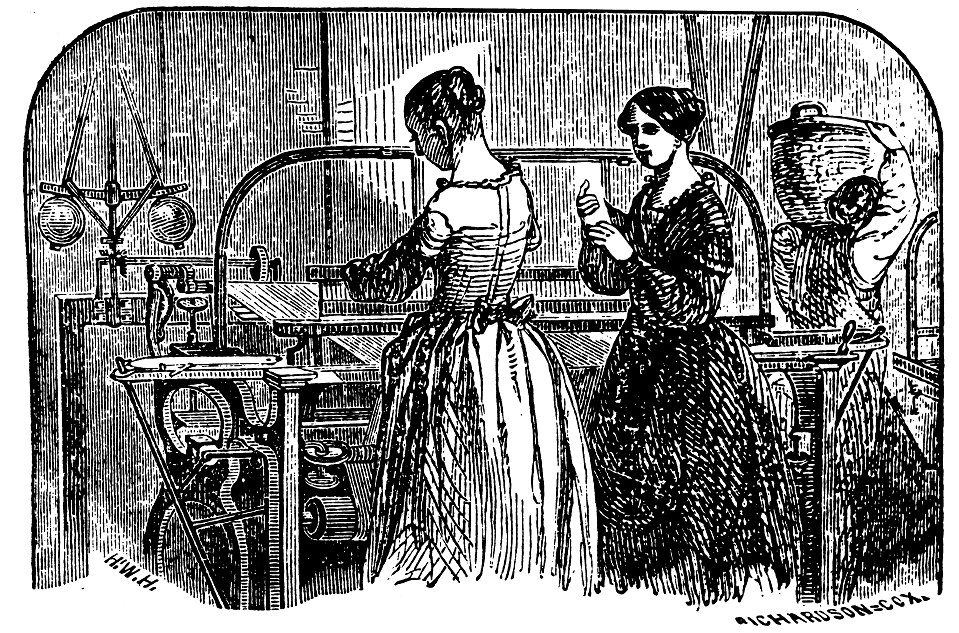
Young, single women were recruited to work in the textile mills. They left the farms and moved into dormitories overseen by matriarchs who kept a close watch over their charges. In Lowell they were called the “Lowell Girls.
An Illustration of Two Mill Girls Working In A Factoryhttps://www.nps.gov/lowe/learn/historyculture/the-mill-girls-of-lowell.htm

The impact of this mechanized production made cheaper, better goods available to people far away from the mills. The production went far beyond textiles. The idea of interchangeable parts developed by Eli Whitney for firearms extended o a myriad of household items.

In 1858 in Monmouth, Maine, two brothers ran a successful dry goods store. Monmouth, close to Augusta, had a rail line going through town and it brought shipped goods from many places. One of the brothers died in his fifties and an inventory had to be done for the probate court. The inventory included a complete inventory of the contents of the store. This remarkable record preserves a thorough listing of the goods available to people in small towns, ranging from utensils to a wide variety of cloth and other manufactured goods. This was the case across the country.

I can’t possibly describe the Industrial Revolution in one blog entry, but it is possible to spin out the implications:

-household goods were available for lower prices
-employment in factories meant a gradual decline in agriculture
-improvements in transportation speed made it possible for goods to be shipped to faraway places

And, it created a greater demand for raw materials. With a burgeoning population the demand for cheap clothing skyrocketed. New England could meet the demand for wool, but it couldn’t produce the other material needed.

Cotton.
https://upload.wikimedia.org/wikipedia/commons/e/e6/NH_74054_Steamer_Planter.jpg

A steamship loaded with cotton bales during the Civil War.

Here’s the connection between slavery and the Industrial Revolution. All the tumblers fell into position to unlock a vast source of wealth. Tobacco had stripped the land in the south of nutrients. Cotton was one of the few crops that could grow in the impoverished soil, but

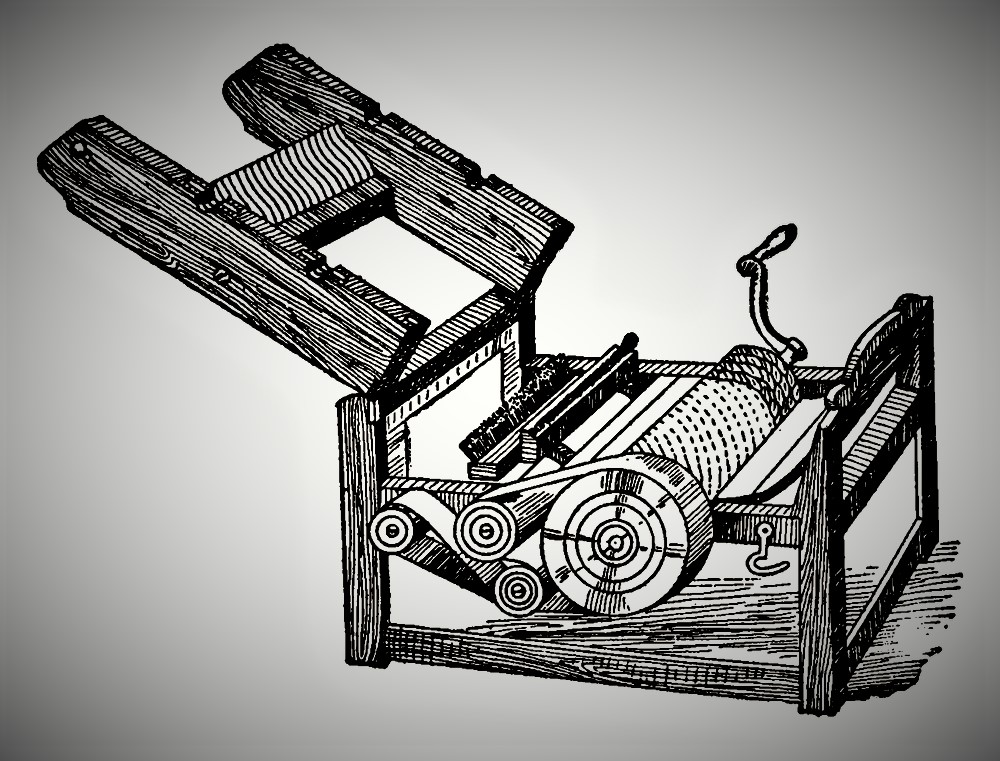
it was expensive and labor intensive work to separate the seeds from the cotton boll, until Eli Whitney invented the cotton gin which could do it mechanically. As a result, slavery expanded significantly. The politics of slavery dominated the first half of the nineteenth century. Even with the end of the importation of slaves in 1808 slavery continued to be a political force. And, slaves became a more valuable commodity (it is very difficult to write this part, thinking of human beings as a commodity) which led to a brisk trade in smuggling slaves throughout this period.


Scourged back by McPherson & Oliver, 1863, retouched.jpg 
A famous photograph of an enslaved man named Gordon, taken in 1863, which was widely reproduced in the Union states and galvanized the fight against slavery.

Slavery was a brutal, inhumane system which turned people into commodities. If they refused to comply, their fate was Gordon's fate. Working in the cotton fields was back-breaking labor, and even children were required to help. The dirty secret of the Industrial Revolution in New England was that it was built on the backs of slaves. Literally.

The failed compromises of 1820 and 1850 gradually led to the dress rehearsal for the Civil War, the Border War, commonly called “Bleeding Kansas,” fought over the issue of slavery in Kansas.


I guess the Civil War is next


Saturday, August 15, 2020

Why the Nineteenth Century Shaped Who Americans Are Today: Part 3, Slavery

 Before I begin, I need to say that slavery is without a doubt the most difficult and painful subject to address in American history. My wife and I are descended from slaveholders. My wife and I are both descended from Admiral John Hawkins, who started the British Atlantic slave trade in the 1570’s. We can’t escape it, so it’s important to discuss it.

As I noted last time, slavery was declining by the time the US Constitution was being drafted in the late 1780’s the subject of slavery was on the table. The Congress that passed the Declaration of Independence (which was and is not a legally binding piece of legislation, just a resolution) eliminated Thomas Jefferson’s citation of it in his draft of the Declaration. This was in order to bring the southern states on board. John Adams famously opposed the elimination of this sentence but to no avail.  The Constitution as passed contained a number of references to slaves as the property of their masters. It also contained the infamous 3/5 compromise, which allowed for each person in bondage to count as 3/5 of a person for purposes of apportioning Congressional districts. Note, of course, that these enslaved people were not counted as US citizens and could not vote.

The Constitution also made provision for the discussion about ending the slave trade, which could not happen before 1807, twenty years after the adoption of the Constitution. Those who were paying attention did so the minute it could be brought up, and the US’ participation in the international slave trade in 1808. This, of course, did not ban the sale of slaves in the United States. The separation of innumerable families, of spouses, parents, and children, continued mercilessly. Human beings were treated like cattle, all in the name of profit. People were beaten, murdered, and brutalized in the name of profit. The impact of this system of exploitation cannot be overstated. It is our nation's original sin, in tandem with the near eradication of the native peoples of this continent.

What the writers of the Constitution did was to kick the proverbial can down the road.

They did so as a timid way to side step the issue, in order to not offend the South, and it didn’t work.

Why? Because of Eli Whitney (remember him?)

When slavery started in the colonies in 1619 it was primarily to provide labor for the growing of tobacco, to which Britain and other Europeans were hopelessly addicted. It was hugely profitable. For awhile it went well, until about the mid-eighteenth century. Cotton had been grown in the South for years but because it had to be processed by hand it was expensive. The  ball of cotton grew inside a boll, a hard exterior. This had to be picked off by hand, making it labor intensive. By the time the Constitution was written the production of tobacco had declined because the soil was depleted after 150+ years of agriculture. Once the cotton gin was introduced it made cotton a profitable crop and its agriculture exploded. This was because the gin mechanically separated the ball of cotton and the hard outer boll. An added factor was that cotton can grow in any type of soil, so the depleted soils of the South were fine.

The writers of the Constitution probably expected that slavery would die a natural death and they may as well not rock the boat by debating it. 

They were wrong.


“King Cotton” caused a massive increase in the need for labor, and slaves became more valuable. By the 1840’s cotton was the largest crop grown in the country, with huge exports supplying the British and French textile industries, and domestically, the textile industry in the Northeast. That means us. The cotton grown in the South went to mills in New England, and mill owners profited from slavery even they looked the other way.

This is how slavery and the Industrial Revolution were tied together. If you ever have the opportunity to see a piece of cotton clothing from pre-Civil War New England, that cotton was grown and processed by people who were forcibly held to work without compensation, enduring unspeakable abuse.

Once the growth of cotton increased after 1793 the South gained even more political advantage. Six of the first seven presidents were slaveholders, the exception being John Adams.

Every time the subject of abolishing slavery came up someone came up with a compromise. Because cotton could grow in the worst soil, it went west to Texas. The Missouri Compromise of 1820 allowed for Missouri to enter the union as a slave state if Maine entered as a free state. Maine was a part of Massachusetts before them, or as some Mainers might point out, Massachusetts was a part of Maine.

The tensions increased as the pressure mounted for slavery to be extended further west. At the same time controls over slaves tightened even further out of fear of rebellion. The country was becoming a powder keg just waiting for someone to light the fuse. By 1850 tensions had continued to mount. The Compromise of 1850, much more complicated than the Missouri Compromise of 1820, defused tensions for awhile. The debate centered around the status of slavery in territory conquered during the Mexican American War (1846-1848). This postponed war for a time but it didn’t last.

How does this affect us today? In perpetuating slavery the President, Congress and the states created two cultures, each dependent on the other. The industrialized North depended on cotton from the South to supply its mills. The cultural differences ever deepened as time went on. We still wrestle with the implications of slavery today. White supremacists who celebrate the legacy of the failed Confederacy ask why African Americans often refer back to slavery, when they themselves hearken back to the Lost Cause and faithfully attend Civil War reenactments. African Americans were robbed of their heritage. That's the bottom line. Their heritage is one of brutality, rape, and inhuman servitude.